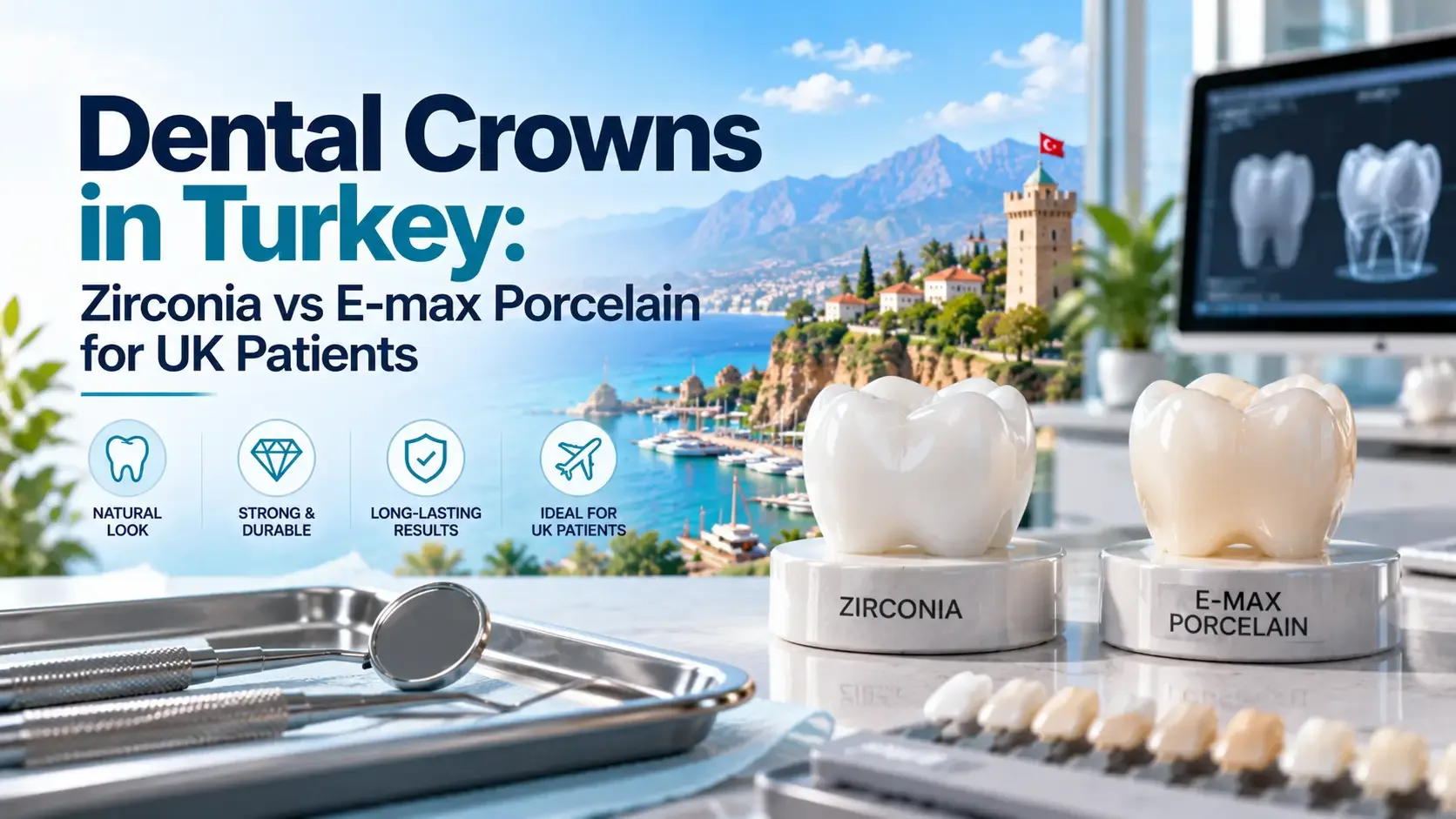
A crown is one of the most common dental treatments there is, and also one of the most expensive to have done privately in the UK. That is why dental crowns in Turkey attract so many UK patients. But a crown is not a single product. The material, the laboratory that makes it and the dentist who prepares your tooth all affect how it looks, how well it fits and how long it lasts. This guide explains what crowns are for, how the two most popular materials, zirconia and E-max porcelain, compare, and what to ask before you book.
What a Crown Does
A crown is a custom-made cap that covers a damaged tooth completely, restoring its shape, strength and appearance. Dentists recommend them when a tooth is too broken down for a filling to hold, after root canal treatment to protect a weakened tooth, to cover a heavily worn tooth or to improve the look of a discoloured or misshapen one. Crowns are also used on top of dental implants. Because a crown surrounds the whole tooth, it can hold a fragile tooth together and spread the forces of biting more safely.
The Main Crown Materials
Several materials are used, and the best choice depends on where the tooth is in your mouth, how heavily you bite and what you want it to look like. The most common modern options are zirconia, E-max (lithium disilicate glass ceramic) and porcelain fused to metal. Full gold and other metal crowns still exist and are very durable, but few patients choose them for visible teeth. Understanding the strengths and limitations of each helps you to have a better conversation with your dentist rather than simply accepting whatever is offered.
Zirconia Crowns
Zirconia is a very strong ceramic material, and it has become a popular choice for crowns, bridges and implant restorations. Its main advantage is strength. It is highly resistant to chipping and fracture, which makes it well suited to back teeth and to patients who clench or grind. Modern zirconia is much more natural looking than the early, chalky-white versions, particularly the layered and multi-shade types. It is also metal-free, so there is no dark line at the gum. The trade-off is that it can be a little less translucent than glass ceramics, depending on the type.
E-max Porcelain Crowns
E-max is a glass ceramic that is prized for its beauty. It is naturally translucent and lets light pass through in a similar way to real enamel, which makes it a favourite for front teeth where appearance matters most. It bonds well to the tooth and can be made very thin, which sometimes allows the dentist to preserve more of your natural tooth. It is strong enough for many situations, but it is not as strong as zirconia, so it is more often recommended for front teeth and premolars than for heavy back-tooth biting.
Zirconia vs E-max: A Simple Comparison
Strength: zirconia is stronger and better for molars, grinding and long bridges.
Appearance: E-max is usually more translucent and often preferred for the front teeth.
Tooth preparation: E-max may allow slightly more conservative preparation in some cases.
Durability: both can last many years with good care, but zirconia is more resistant to fracture.
Cost: prices vary by clinic and laboratory, and the difference between them is often small.
The honest answer is that neither is universally better. A good dentist chooses the material for the specific tooth, not because it happens to be the one in the promotional package.
What the Procedure Involves
A crown normally takes two stages. At the first appointment the tooth is examined, X-rayed if needed, and shaped under local anaesthetic to make room for the crown. A scan or impression is taken, the colour is matched and a temporary crown is fitted to protect the tooth. The crown is then made in a dental laboratory. At the second appointment, the temporary crown is removed, the new crown is tried in, checked for fit, colour and bite, and then permanently cemented. In Turkey the full process is often completed within a matter of days, which is why crowns suit a short trip.
Does Preparing a Tooth for a Crown Damage It?
Preparing a tooth means removing a layer of healthy structure so that the crown has room to sit without becoming bulky. This is irreversible, which is why a crown should be recommended only when it is really needed. A responsible dentist will consider whether a filling, an onlay or another conservative option would do the job first. With 32 years of dental experience behind our approach, our priority is to protect as much of your natural tooth as possible and to be honest when a simpler treatment will serve you better.
Crowns After Root Canal Treatment
A tooth that has had root canal treatment is often more brittle, and a crown is frequently recommended to protect it from fracture, especially on back teeth. If you have had a root canal, it is worth asking whether the tooth needs a crown straight away, and what the long-term outlook is. Our guide to root canal treatment in Turkey explains how the two treatments fit together. Having both carried out by the same team can also simplify the planning and the follow-up.
Why Cheap Crowns Can Be a False Economy
The price of crowns varies enormously, and the lowest offers are often not directly comparable to a higher-quality treatment. The laboratory that makes the crown matters, as does the quality of the materials, the time spent shaping the tooth and checking your bite. A poorly fitting crown can leave a gap at the edge where bacteria collect, causing decay beneath it, or it can change your bite in a way that causes discomfort. If a price looks far lower than everything else, ask what is included and what is different.
How Long Do Crowns Last?
With good care, a well-made crown can last ten to fifteen years or longer, though there is no guarantee, and individual results vary. How long yours lasts depends on the material, your oral hygiene, whether you grind your teeth and the condition of the tooth underneath. The crown itself does not decay, but the tooth beneath it can, so brushing, cleaning between your teeth and regular hygiene visits remain essential. A night guard is often recommended if you grind your teeth, since it protects both the crowns and your natural teeth.
Matching Crowns to Your Natural Teeth
One of the most common concerns is whether a crown will look natural next to your other teeth. This depends on careful shade selection, the skill of the laboratory technician and the shape and surface finish of the crown. Whitening should be done before shade matching if you are planning it, since crowns do not change colour. For a single front tooth, a good clinic will often involve the technician directly, or take photographs, to get the colour and character right.
Aftercare When You Are Back in the UK
Once the crown is fitted, look after it as you would a natural tooth. Brush twice a day, clean between your teeth and avoid biting on very hard objects such as ice or pen tops. Keep up regular check-ups and hygiene visits with your UK dentist, and ask for a copy of your treatment record, including the type of crown and the cement used. If a crown feels high, becomes loose or you notice sensitivity that does not settle, contact the clinic rather than waiting. Early adjustments are usually simple.
Questions to Ask Before You Book
Which material do you recommend for this tooth, and why?
Where is the crown made, and is it made in a dental laboratory or a milling unit in the clinic?
Is there a less invasive option, such as an onlay, that might work for me?
How many appointments will I need, and how long will I need to stay?
What guarantee or remake policy do you offer if the crown fails?
Gold, Metal and Other Alternatives
Porcelain fused to metal crowns have a long record and are still widely used, particularly where strength matters. They have a metal core covered with porcelain, which can sometimes show as a dark line at the gum edge as the gum recedes. Full gold crowns are extremely durable and kind to opposing teeth, but their appearance puts most patients off for anything but the back teeth. Modern ceramics have largely replaced both for visible teeth, though your dentist may still recommend them in particular situations.
Can a Crown Be Replaced Later?
Yes. Crowns do not last forever, and replacing one is a routine procedure. If the original crown has been well made and recorded, a future dentist can use the same details to make a close match. That is one more reason to keep a copy of your treatment notes, the material used and the shade chosen. If a crown fails early because of a fit problem or a fracture, ask the clinic what its remake policy is, and how that works when you live in another country.
Getting Started
If you are thinking about dental crowns in Turkey, send us your recent X-rays or a few clear photos of the tooth or teeth concerned. We'll tell you honestly whether a crown is the right treatment, which material we would suggest and how many days you would need to allow.