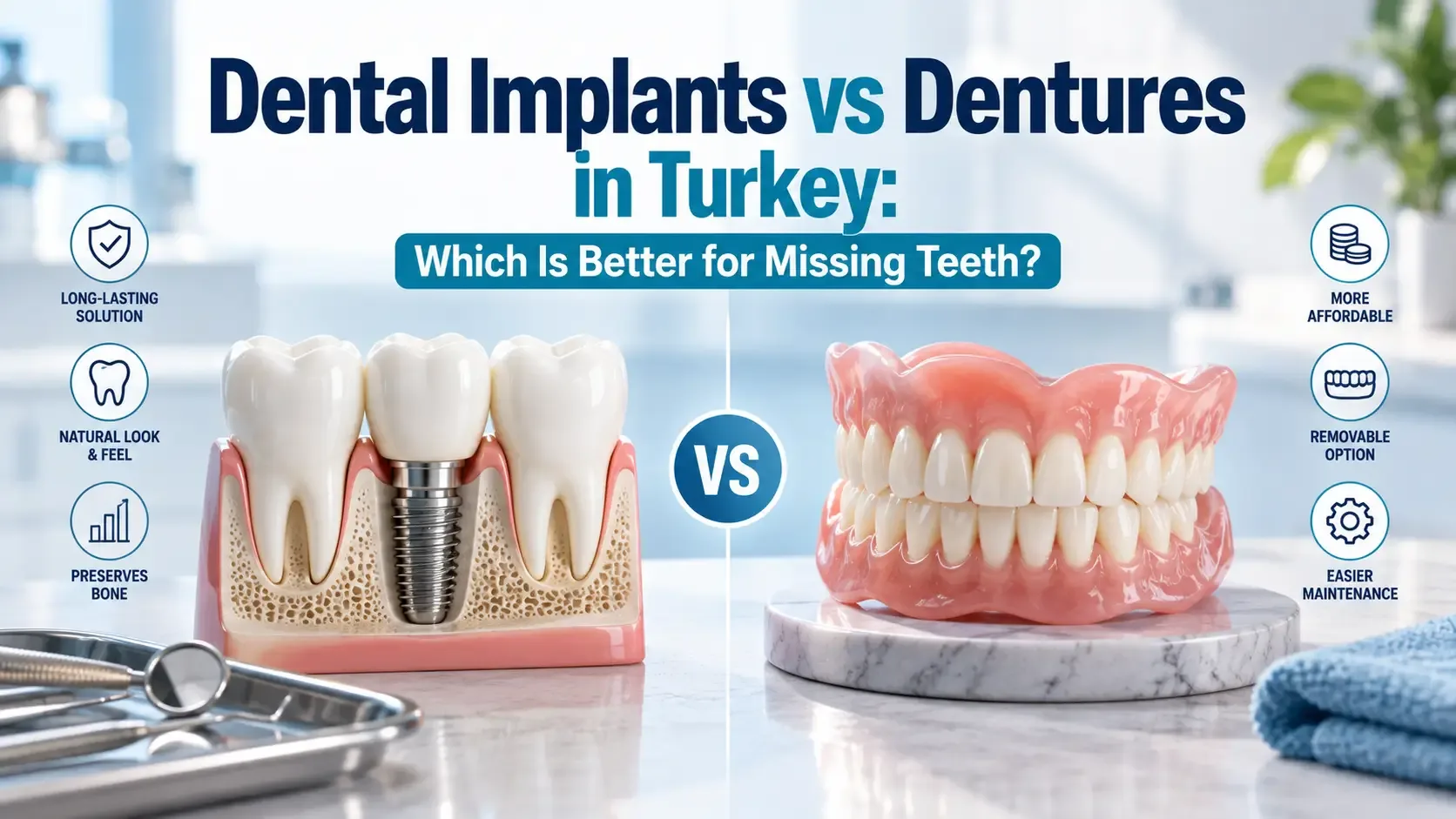
If you're missing several teeth or facing the prospect of losing most of your remaining natural teeth, dentures and implants are usually the two options put in front of you. Both have a long history of restoring function and appearance, but they work in fundamentally different ways, and the right choice depends on your bone health, lifestyle, and how much you're willing to invest upfront versus over time. This guide compares dental implants and dentures directly, so you can make a decision based on what actually matters for your situation.
Two Very Different Approaches to Replacing Missing Teeth
Dentures are removable prosthetic teeth that rest on your gums, held in place by suction, an adhesive, or clips onto any remaining natural teeth. Dental implants are titanium posts placed directly into your jawbone, topped with a fixed crown or bridge that functions and feels far closer to natural teeth. The fundamental difference is that dentures sit on top of your gums, while implants integrate with the bone beneath them — a distinction that shapes almost every other difference between the two options.
Comfort and Everyday Function
This is where the gap between the two options is usually most noticeable to patients. Dentures can shift or feel loose during eating and speaking, particularly lower dentures, which rely more on suction and have less natural retention than upper dentures. Many denture wearers also change what they eat over time, avoiding sticky, chewy or hard foods that risk dislodging the denture. Implants function much closer to natural teeth, since they're fixed in place and don't move during chewing or speaking, which is why patients moving from dentures to implants often describe it as rediscovering foods they'd quietly given up on for years.
What Happens to Your Jawbone Over Time
This is one of the most significant long-term differences and one of the least discussed upfront. Your jawbone needs the stimulation of a tooth root to maintain its density; without it, bone gradually resorbs and shrinks over the years. Dentures sit on top of the gum and provide no stimulation to the bone underneath, which is why denture wearers often notice their dentures fitting less well over time — not because the denture changed, but because the jawbone beneath it has continued to shrink. Implants, by replacing the tooth root itself, provide ongoing stimulation that helps preserve bone density in a way dentures simply cannot.
Speech and Confidence
Dentures can affect speech, particularly in the initial adjustment period, and some patients continue to notice a slight change in how certain sounds form, especially with upper dentures covering part of the roof of the mouth. Implants don't cover the palate and don't shift during speech, which most patients find makes speaking feel entirely normal within a short adjustment period. Confidence in social situations — eating out, laughing, speaking closely with others — is one of the most commonly cited reasons patients choose implants over dentures when both are genuinely viable options.
Upfront Cost vs Long-Term Cost
Dentures are considerably less expensive upfront than implants, which makes them an accessible option for patients working within a tighter initial budget. However, dentures typically need relining or replacing every five to eight years as your bone and gum shape change, and this ongoing cost adds up over a couple of decades. Implants cost significantly more initially, but with proper care can last decades, sometimes a lifetime, with the main ongoing cost being occasional crown replacement rather than replacing the entire structure. Viewed over a twenty-year horizon rather than a single purchase, the cost gap between the two options narrows considerably.
The Middle Ground: Implant-Supported Dentures
For patients who want more stability than a standard denture but aren't ready for, or don't need, a full set of individual implants, implant-supported dentures offer a genuine middle ground. A small number of implants — often four — are placed to anchor a removable or fixed denture, dramatically improving stability and chewing function compared to a standard denture while costing less than replacing every individual tooth with its own implant. This is often the option recommended for patients who've been wearing a loose, uncomfortable denture for years and want a significant functional upgrade without necessarily committing to a full-arch fixed solution like All-on-4.
Who Tends to Suit Each Option
Dentures suit patients prioritising the lowest upfront cost, or those who aren't suitable candidates for implant surgery due to bone loss or certain medical conditions.
Implants suit patients who want the closest possible function to natural teeth and are willing to invest more upfront for a longer-lasting result.
Implant-supported dentures suit patients wanting significantly better stability than a standard denture without the cost of individual implants throughout the mouth.
A mixed plan — implants for some areas, a denture or bridge for others — is common and entirely reasonable depending on which teeth are missing and your bone health at each site.
Why Bone Loss Sometimes Decides the Question for You
If you've worn dentures for many years, significant bone loss may have already occurred in the areas without teeth, which can affect whether implants are immediately viable without additional bone grafting first. This isn't a reason to rule out implants, but it does mean an honest assessment of your bone volume needs to happen before deciding, since it directly affects both the timeline and the realistic options available to you.
Making the Decision With Full Information
With 32 years of dental experience helping patients weigh exactly this decision, the honest answer is that there's no universally correct choice — only the choice that best fits your bone health, budget, and how much you value the closer-to-natural function implants provide. A proper consultation, including a scan to assess your bone, is what turns this from a general comparison into a specific recommendation for your mouth.
What Recovery Looks Like for Each Option
Recovery expectations differ sharply between the two paths. A conventional denture typically requires a short adjustment period of a few weeks while your gums get used to the fit, with occasional sore spots that are usually resolved with minor adjustments. Dental implants involve a surgical placement, so you can expect some swelling and mild discomfort for several days, followed by a healing period of a few months while the implant fuses with the jawbone before the final crown or bridge is fitted. Implant-supported dentures sit in between: the surgical placement is similar to standard implants, but because fewer implants are used to anchor a full arch, planning your trip around the healing timeline is usually more straightforward than a full set of individual implants.
How Each Option Affects Your Diet and Daily Habits
Denture wearers often need to adapt their diet, avoiding very sticky or hard foods that can dislodge a removable appliance, and some notice a mild change in how strongly they can taste or feel temperature due to the denture base covering part of the palate. Implants, once fully healed, function close enough to natural teeth that most patients eat whatever they like without giving it a second thought. This difference in daily living is one of the most common reasons patients who started with dentures later ask about upgrading to implants or implant-supported dentures.
How Clinics Assess Which Option Suits You
A proper assessment goes beyond simply asking which option you prefer. It typically includes a full examination, X-rays or a 3D scan to check bone volume and density, a review of your bite and gum health, and a conversation about your budget, timeline, and how many trips you're able to make. Patients sometimes arrive assuming they need one option and leave with a different, better-suited recommendation once the clinical picture is clear, which is exactly why this assessment matters more than reading comparisons online.
A Note on Long-Term Maintenance
Whichever option you choose, long-term success depends partly on maintenance. Dentures need regular relining as your jaw shape changes over time and should be removed nightly for cleaning. Implants require the same diligent brushing and flossing as natural teeth, plus periodic professional check-ups to monitor the surrounding gum and bone. Neither option is entirely maintenance-free, so factoring realistic long-term care into your decision, alongside cost and comfort, gives you a fuller picture before you commit.
There's no need to decide alone. A short consultation, backed by a look at your X-rays or a scan, is usually enough to narrow the comparison down to one or two realistic options for your specific case.
Getting Started
If you're weighing up dentures against implants for missing teeth, send us a few photos of your current teeth or dentures along with any X-rays you have. We'll give you an honest assessment of your options, including whether implant-supported dentures might be the right middle ground for your case.