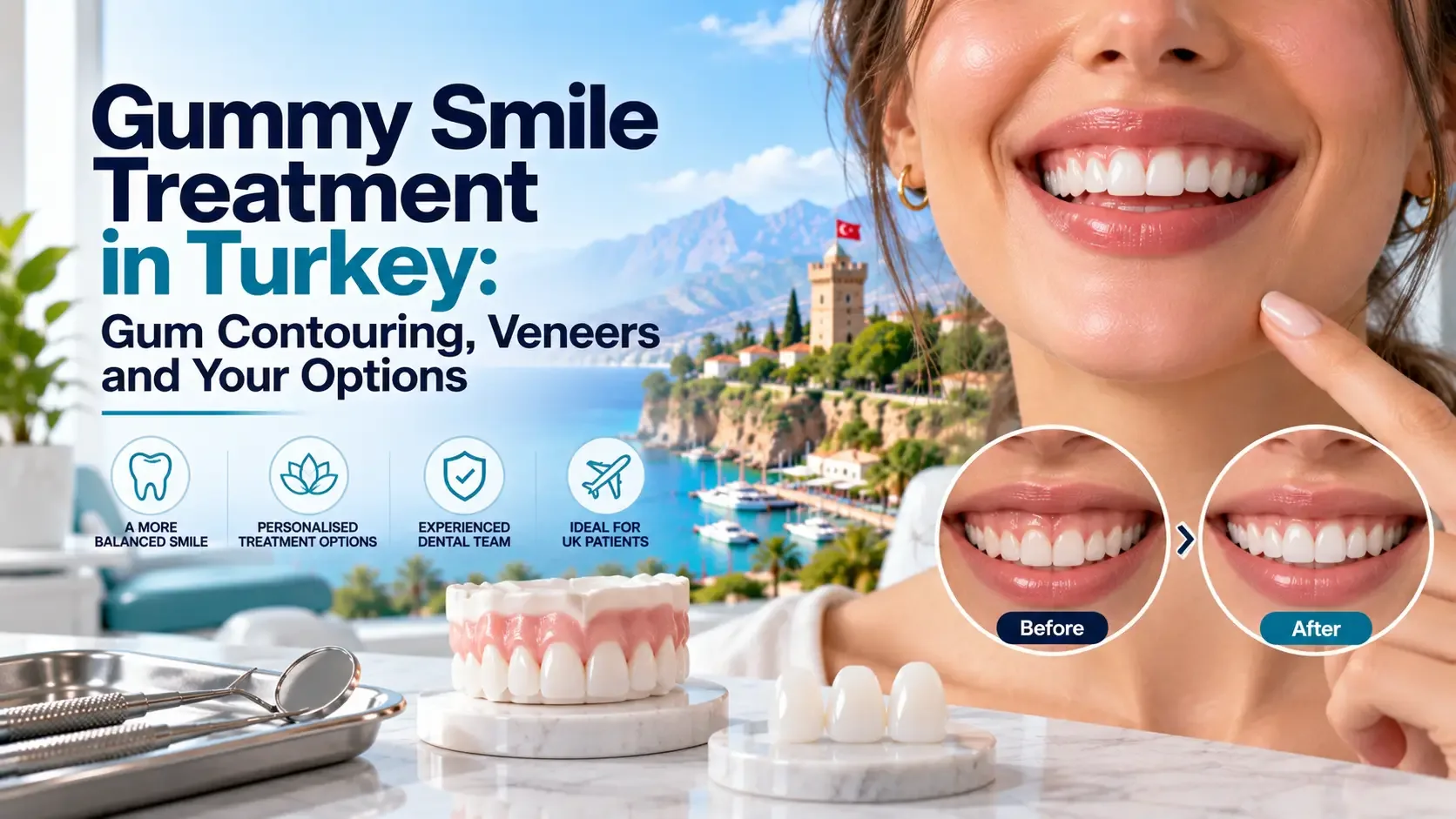
A gummy smile, where a noticeable amount of gum shows when you smile, is one of the most common reasons people feel self-conscious about their teeth, even when the teeth themselves are healthy. The good news is that it is treatable, and there is more than one way to treat it. The less obvious news is that the right treatment depends entirely on what is causing the problem. This guide explains the main causes of a gummy smile, the treatment options available, and how gummy smile treatment in Turkey typically works for UK patients.
What Counts as a Gummy Smile?
A certain amount of gum showing when you smile is completely normal. Most people show a small band of gum, and a few millimetres is generally regarded as attractive. A gummy smile, or excessive gingival display, is usually considered to be when several millimetres of gum are visible above the upper teeth, so that the smile looks dominated by gum rather than teeth. Whether it bothers you is a personal matter. What matters clinically is to work out the cause, since that determines what will fix it.
The Main Causes of a Gummy Smile
Teeth that look short because the gum has grown further down the tooth than it should, sometimes called altered passive eruption.
An upper lip that lifts higher than average when you smile, often called a hypermobile lip.
A short upper lip, which leaves more gum on show.
Excess growth of the upper jaw bone, known as vertical maxillary excess.
A combination of two or more of these factors.
It is quite common for more than one cause to be present, which is why the first step is a careful assessment.
Why Diagnosis Comes First
Two patients can have a similar looking gummy smile and need entirely different treatments. Trimming the gum will help someone whose teeth are partly buried under excess gum, but it will do little for someone whose problem is an overactive lip or a long upper jaw. A good clinic examines your smile at rest and in motion, takes photographs and measurements, and may use X-rays or a scan to see how much bone covers the roots of your teeth. Be cautious of anyone who recommends a procedure without carrying out this assessment.
Gum Contouring
Gum contouring, also known as gingivectomy or gum reshaping, involves removing a small amount of gum tissue to expose more of the tooth and create an even gum line. It is carried out under local anaesthetic, usually in a single appointment, and it can be done with a laser or with fine surgical instruments. It works best when the teeth are shorter than they should be because of excess gum. If the underlying bone is too close to the gum edge, the dentist may need to reshape a little bone as well, which is known as crown lengthening.
Laser vs Scalpel for Gum Reshaping
Many clinics advertise laser gum contouring, and lasers can be an excellent tool. They allow precise cutting with limited bleeding and often a comfortable recovery. A scalpel in the right hands can achieve an equally good result. What matters most is the planning and the judgement of the dentist, not the instrument. A laser will not make up for a poorly designed gum line. If you are comparing clinics, ask how the shape of the new gum line will be planned and how it will be checked with you before treatment starts.
Lip Repositioning
When the cause is a lip that moves too high, lip repositioning surgery may be considered. A thin strip of tissue inside the upper lip is removed, and the lip is stitched in a slightly lower position, which limits how far it can lift when you smile. It is a more involved procedure than gum contouring and is typically carried out by an oral or plastic surgeon. Recovery takes longer, and the result can be affected by how the lip heals. It deserves a frank discussion of the benefits, risks and the chance of some relapse over time.
Botulinum Toxin for a Hypermobile Lip
In some patients with an overactive upper lip, small amounts of botulinum toxin are used to relax the muscles that lift the lip. It is non-surgical and reversible, and the effect typically lasts a few months before needing to be repeated. It will not help if the main cause is excess gum or jaw growth. It can be a useful way to see how reducing lip movement changes your smile before deciding on something permanent, but it should only be given by a suitably qualified practitioner.
Veneers and Crowns for a Gummy Smile
When the teeth themselves are small or worn, adding length with veneers or crowns can rebalance the proportions of the smile. This is often combined with gum contouring, because the shape of the gum and the shape of the teeth work together. Our guide to natural-looking veneers explains how shade and shape are planned. With 32 years of dental experience, we regard the gum line as part of the design of a smile, not something to be treated separately from the teeth.
Orthodontics and Jaw Surgery
If the cause is a long upper jaw, a more complex approach may be needed. Orthodontic treatment can sometimes reduce the problem by moving the teeth, and in more severe cases jaw surgery, called orthognathic surgery, repositions the upper jaw. This is major treatment and is only recommended after careful assessment. Our guide to clear aligners in Turkey explains how aligners fit into orthodontic planning. A good clinic will tell you honestly if your case is beyond what a simple cosmetic procedure can achieve.
What Recovery Looks Like
After gum contouring, the gums are usually tender for a few days and heal within one to two weeks, although the final shape continues to settle over several weeks. You will be advised to eat soft foods, avoid very hot or spicy food and keep the area clean with gentle brushing and a prescribed mouthwash. Some bleeding and swelling in the first days is normal. Avoid smoking, which slows healing. It is wise to allow around a week in Turkey so that any early problems can be checked.
Combining Gum Contouring With Other Treatment
Many UK patients combine gum contouring with veneers or crowns in a single trip. The order matters. The gum is usually shaped first, and the restorations are made after the tissue has had time to settle, so the final teeth sit perfectly against the new gum line. Your dentist will explain whether this can be done in one visit or whether a second visit is needed. It is another reason to have a single team plan the whole smile.
Realistic Expectations and Risks
Gum contouring is usually predictable when the problem is excess gum. Even so, as with any procedure, there are risks, including sensitivity, uneven healing, gum recession and the possibility that the gum partly regrows. Surgery on the lip or jaw carries additional risks. A responsible clinic will explain these clearly and will not promise that your smile will look like a photo you have seen online. Your anatomy sets the limits of what is possible.
Questions to Ask Before You Book
What is causing my gummy smile, and how did you work that out?
Which treatment do you recommend, and what are the alternatives?
Can you show me how the new gum line will look before treatment?
How long is recovery, and how long should I stay in Turkey?
What happens if the result is not what we planned?
Gummy Smile Treatment and Your Gum Health
Healthy gums are essential before any gum reshaping. If you have gum inflammation, bleeding or periodontal disease, that needs to be treated first, because cutting inflamed tissue leads to poorer healing and a less predictable result. A good clinic will check your gum health, ask about smoking and may recommend a hygiene appointment before surgery. Our guide to gum disease treatment in Turkey explains how that works. Spending a little time getting the gums healthy first makes the cosmetic result far more reliable.
Is Gummy Smile Treatment Permanent?
Surgical gum contouring is generally long lasting when the cause was excess gum tissue, since the tissue that is removed does not usually return. Lip repositioning can see some relapse as the lip stretches over time. Botulinum toxin is temporary by design. Orthodontic and jaw surgery results are stable if they are properly planned and maintained. Whatever you choose, good oral hygiene helps to keep the gums stable, and an honest clinic will tell you what degree of permanence to expect for your type of gummy smile.
Why Some Patients Choose Not to Treat It
Not every gummy smile needs correcting. Many people find that their smile is part of their character, and some are perfectly happy once they understand what causes it. Treatment is a personal decision, and you should never feel pressured. If you are unsure, a consultation can help you to see what is possible without any commitment, and a good clinician will respect your choice either way.
Getting Started
If you're considering gummy smile treatment in Turkey, send us a few clear photos of you smiling widely, front on and from the side, together with any recent X-rays. We'll tell you what we think is causing your gummy smile, which options look suitable and how many days to allow.