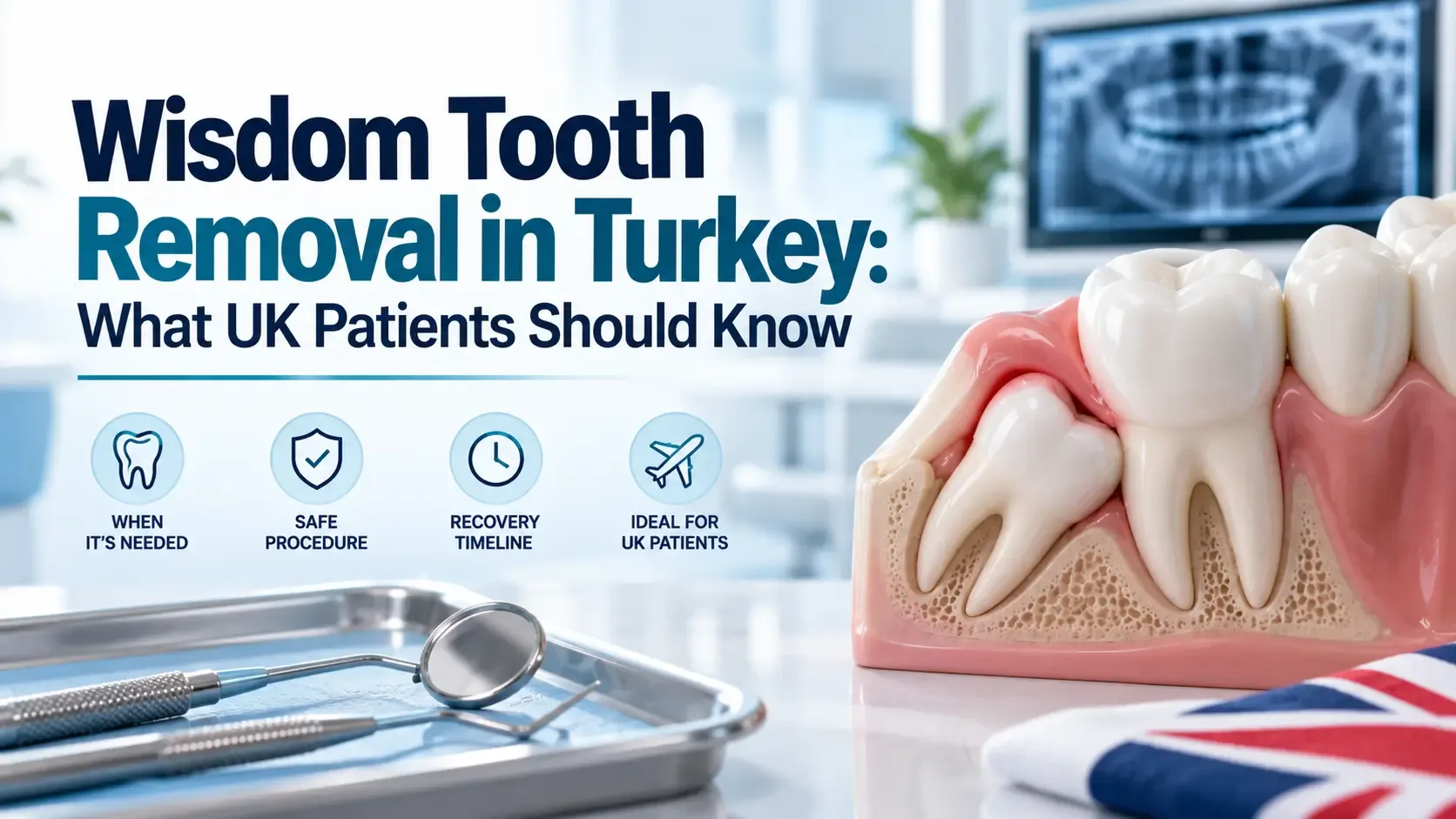
Wisdom teeth are one of the most common reasons people end up waiting months for a dental appointment in the UK. If you've been told your wisdom teeth need to come out, or you've been living with repeated pain and infections while sitting on a waiting list, it's understandable that you've started to look at options abroad. This guide explains how wisdom tooth removal in Turkey actually works for UK patients: what happens at the assessment, how the surgery is carried out, what recovery looks like, and when it makes sense to travel for it.
Why Wisdom Teeth Cause Problems
Wisdom teeth, or third molars, are the last teeth to come through, usually in your late teens or twenties. In many mouths there simply isn't enough room for them. They can become impacted, meaning they are stuck beneath the gum or against the neighbouring tooth, or they may come through at an angle that traps food and bacteria. The result can be recurring gum infections known as pericoronitis, decay in the tooth next to them, cysts in rare cases, and pain that flares up repeatedly. Not every wisdom tooth needs to come out, but when one is causing repeated trouble, removal is usually the sensible long-term answer.
Why UK Patients Look Abroad for Wisdom Tooth Removal
The reasons are mostly practical. NHS waiting times for oral surgery referrals can be long, and many NHS practices only remove wisdom teeth when there is clear pathology, which can leave you in discomfort for a long time. Private treatment in the UK is available, but surgical extractions of impacted teeth can be expensive, particularly if you need all four removed. Turkey offers private oral surgery with much shorter waiting times, and many patients combine the procedure with other dental work they were already planning. For a procedure that is usually completed in a single visit, it can also be easier to travel for than a multi-stage treatment such as implants.
What Happens at the Assessment
Before any surgery, the position of each wisdom tooth needs to be understood precisely. A panoramic X-ray is the standard starting point, and in more complex cases a 3D scan is used to see exactly how close the roots are to important structures. In the lower jaw, that means the nerve that supplies feeling to your lip, chin and tongue. In the upper jaw, it means the sinus. Many clinics will review a recent UK X-ray before you travel, which means you can get a realistic idea of the difficulty of the case and the likely cost before booking flights. A final decision is always made once you've been examined in person.
Simple Extractions vs Surgical Removal
Wisdom teeth vary enormously in how difficult they are to remove. A fully erupted upper wisdom tooth can sometimes come out in minutes, much like any other extraction. A lower tooth that is angled sideways and buried in bone is a different matter. It typically requires a small incision in the gum, the removal of a little bone around the tooth, and sometimes sectioning the tooth into pieces so it can be lifted out gently. This is surgical removal, and it is routine for an experienced oral surgeon. Knowing which category your teeth fall into is the single biggest factor in how long the procedure takes and how you will feel afterwards.
Local Anaesthetic, Sedation or General Anaesthetic
Most wisdom tooth removals are done under local anaesthetic, so the area is completely numb and you feel pressure but not pain. If the idea of surgery makes you anxious, or if you need several teeth removed in one sitting, sedation is a common option and is described in more detail in our guide to sedation dentistry in Turkey. Some clinics can also arrange general anaesthesia in a hospital setting for complex or multiple extractions. The right choice depends on your health, your anxiety levels and the difficulty of the case, and it should be discussed openly at your assessment rather than decided on the day.
What the Surgery Is Actually Like
Once you are numb, the surgeon will make a small opening in the gum if the tooth is not fully through, remove any bone that is blocking the way, and take the tooth out, often in sections. The area is then cleaned and closed with stitches, usually dissolvable ones. Each tooth typically takes somewhere between ten and forty-five minutes depending on how deeply it sits, so having all four removed in one visit is realistic for many patients. With 32 years of dental experience behind our approach, the focus is on being gentle with the surrounding bone and gum, since that is what makes the biggest difference to how comfortable your recovery is.
The First Few Days of Recovery
Some swelling, tenderness and stiffness in the jaw is normal and is usually at its worst around the second or third day before easing. Bruising on the cheek can appear and is nothing to worry about. Most people are comfortable with simple pain relief as advised by their surgeon, and use cold packs on the outside of the face in the first day or so. A soft diet is important at the start, and you should avoid vigorous rinsing, smoking and using a straw, because these can disturb the blood clot that forms in the socket. Looking after that clot is the single most useful thing you can do to protect your healing.
Dry Socket and Other Risks
Every surgical procedure carries some risk, and it is better to know the main ones. Dry socket happens when the blood clot is lost or fails to form, exposing the bone and causing a deep, throbbing pain that typically starts a few days after the extraction. It is more likely after lower wisdom tooth removal and in smokers. Infection, prolonged bleeding and temporary numbness near the nerve are less common but possible. Permanent nerve changes are rare, which is exactly why the scan and the surgeon's experience matter so much. A good clinic will explain these risks plainly and tell you what to watch for after you leave.
When Can You Fly Home?
This is one of the most common questions from UK patients. In most straightforward cases, patients feel well enough to fly within a few days, but the safest approach is to build in a buffer rather than booking a flight for the day after surgery. Swelling, tiredness and the need for a check-up all argue for a few extra days. Your surgeon will want to review the area and, if needed, remove stitches before you travel. If you have had a lower wisdom tooth surgically removed, or all four at once, planning a longer stay is usually more comfortable than rushing home.
How Many Days Should You Plan For?
Day one: assessment, scan if needed, and often the surgery itself on the same day once the plan is agreed.
Days two to three: rest, soft food and a quick check of the surgical sites.
Days four to seven: a follow-up visit, review of healing and stitch removal if non-dissolvable stitches were used.
After that: most people are comfortable travelling and returning to normal routine, with a soft diet for a little longer.
A stay of around four to seven days is a realistic plan for most patients, and it gives you time to rest properly instead of travelling while swollen and sore.
Combining Wisdom Tooth Removal With Other Dental Work
Many UK patients who travel for dental treatment have a longer list of work than just their wisdom teeth. It makes sense to plan the order carefully. Wisdom teeth that are causing infection are usually dealt with first, because infection can interfere with other treatment. Planned work such as fillings, crowns or veneers can often be scheduled around the healing period. If implants or major restorative work are on your list, the timing of the extractions matters, and your surgeon should explain how they fit into the overall plan rather than treating them as a separate matter.
What to Do If Something Doesn't Feel Right Back in the UK
Most recoveries are uneventful, but you should know what to do if they are not. Pain that gets worse after the first few days, a bad taste, fever, or swelling that increases rather than eases are all reasons to get in touch with your clinic straight away. A good clinic will ask for photos, guide you remotely and, if necessary, help you arrange to be seen by a UK dentist. Before you travel, ask for your X-rays and a written summary of the procedure so that any dentist you see at home has the full picture.
Questions Worth Asking Before You Book
Who will be performing the surgery, and how many wisdom tooth extractions do they carry out each month?
Will you review my existing X-ray before I travel, and will a scan be taken on arrival?
What anaesthetic or sedation options are available, and what do they cost?
What follow-up is included, and how do I reach you if I have a problem after I get home?
Will I receive copies of my X-rays and a written treatment summary?
Is Wisdom Tooth Removal in Turkey Right for You?
For many UK patients, the answer is yes, particularly when the alternative is a long wait in pain or a high private quote. It is a sensible choice if your case is straightforward to moderately complex, you are in good general health, and you can allow a few days to recover before travelling home. It is worth being more cautious if your wisdom teeth sit very close to the nerve, if you have significant medical conditions, or if you cannot spare enough time. An honest assessment of your scan will tell you which group you belong to.
Getting Started
If you'd like to find out whether wisdom tooth removal in Turkey makes sense for you, send us a recent X-ray or panoramic scan along with a brief description of your symptoms. We'll tell you honestly how complex the case looks, what to expect, and how many days to allow, so you can decide with the full picture in front of you.