



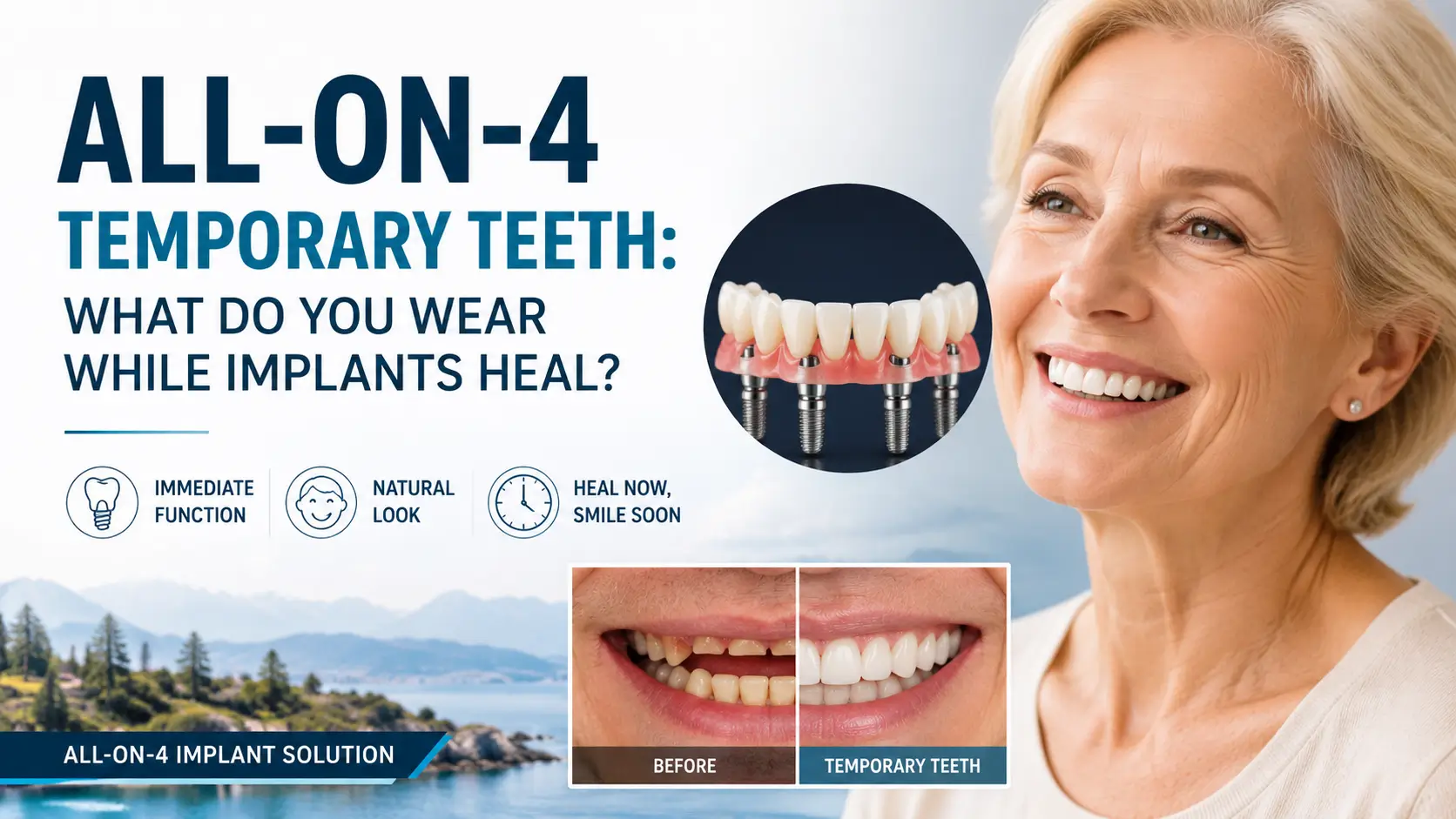
One of the most common questions from patients considering All-on-4 in Turkey isn’t about the implants themselves — it’s about what happens in between. If your implants need several months to heal before the final, permanent bridge can be fitted, what exactly will you be wearing during that time? Will it look obviously temporary? Can you eat normally? Will people be able to tell? This guide answers those practical, everyday questions so you know exactly what to expect from the moment your implants are placed to the day your final teeth are fitted.
The short answer is that you won’t be sent home with a visible gap or an old-style removable denture while you heal. All-on-4 is specifically designed around a fixed temporary solution from day one — but understanding exactly how that works, and its limitations, makes the healing period far less stressful to plan for.
What All-on-4 Actually Involves
All-on-4 replaces a full arch of missing or failing teeth using just four strategically placed implants, which support a full bridge of replacement teeth. Because there are only four implant points rather than one per tooth, and because the implants are angled to maximise contact with your existing bone, many patients are candidates for immediate, fixed temporary teeth on the very same day as surgery — something that isn’t possible with most traditional implant approaches.
The Temporary Teeth You’ll Wear During Healing
In almost all All-on-4 cases, you’ll be fitted with a fixed temporary bridge on the day of surgery, usually made from a lightweight acrylic material. This is not a removable denture that you take out at night — it’s screwed onto the implants themselves and stays in place throughout the healing period, functioning as a full set of teeth while the implants integrate with your jawbone underneath. This is one of the biggest advantages of the All-on-4 protocol over older full-mouth restoration methods, which often required patients to go without fixed teeth, or to wear a loose denture, for months at a time.
The temporary bridge is designed to closely resemble the shape and general appearance of your planned final teeth, though it’s intentionally built a little lighter and less bulky than the final zirconia or acrylic bridge, partly to reduce pressure on the healing implants and partly because some minor adjustments to shape or bite are common during the healing months.
The First 24 to 72 Hours: What to Expect
Immediately after surgery, it’s normal to experience swelling, mild bruising and some tenderness around the jaw and gums, which usually peaks around 48 hours after the procedure before starting to improve. Most patients manage this comfortably with the pain relief provided by their dental team. Your temporary bridge will already be in place when you leave the clinic, so you won’t experience a toothless gap at any point — but your bite and speech may feel unfamiliar for the first few days simply because you’re adjusting to a full new set of teeth at once.
Eating With Temporary Teeth: The First Weeks
For the first two to three weeks, you’ll be advised to stick to a soft food diet — think scrambled eggs, soups, mashed vegetables, soft pasta and similar foods that require minimal chewing pressure. This isn’t about the temporary teeth themselves being fragile, but about protecting the implants underneath while they begin to integrate with the bone. Biting into anything hard, crunchy or sticky during this early period puts unnecessary pressure on implants that haven’t yet fully stabilised.
From around three to six weeks onward, most patients can gradually reintroduce firmer foods, though very hard or tough foods — nuts, hard crusty bread, chewy meat — are usually best avoided until the final bridge is fitted, simply as a precaution. Your dental team will give you a personalised timeline based on how your specific healing is progressing.
Speaking and Adjusting to Your Temporary Teeth
It’s common to notice a slight change in speech for the first week or two, since your tongue and lips need to adjust to the shape and thickness of the new bridge, particularly around certain sounds. This settles down quickly for the vast majority of patients as the mouth adapts, generally within one to two weeks of near-constant use. Reading aloud for a few minutes each day during this adjustment period is a simple trick many patients find helps speech settle back to normal more quickly.
Appearance: Will Your Temporary Teeth Look Natural?
Temporary All-on-4 bridges are designed to look presentable in everyday situations — they’re shaded and shaped to blend reasonably well with a natural smile, not left as an obviously unfinished placeholder. That said, they are a genuine step down in refinement compared with the final prosthesis, which is precision-fitted to your bite, gum contours and facial proportions after healing is complete. Most patients are comfortable being seen socially and at work throughout the healing period, though some do notice the temporary teeth look slightly less polished up close or in bright light compared to the finished result.
Caring for Your Temporary Bridge During Healing
- Clean around the bridge and gumline gently with a soft brush, as directed by your dental team.
- Use any prescribed antibacterial mouthwash consistently during the early healing weeks.
- Avoid smoking during the healing period, since it significantly slows implant integration.
- Attend any scheduled check-ins so your dentist can confirm healing is progressing as expected.
- Contact your clinic promptly if the temporary bridge feels loose, since this should never happen and needs prompt attention.
How Long You’ll Wear Them Before the Final Prosthesis
Most patients wear their temporary All-on-4 bridge for between four and six months, allowing time for full osseointegration before the final, permanent bridge — typically in zirconia or a reinforced acrylic hybrid — is fitted. With 32 years of dental experience across full-arch implant cases, this healing window is never rushed for the sake of a faster finish; a bridge fitted before the implants have properly integrated is one of the most preventable causes of long-term All-on-4 complications, which is exactly why the temporary phase exists in the first place.
What If Something Feels Wrong With Your Temporary Bridge
Minor adjustments to the temporary bridge are a normal part of the healing process — a slightly uneven bite point or a small area of gum irritation can usually be resolved with a quick chairside adjustment. What should never be treated as normal, however, is a temporary bridge that feels loose, rocks when you bite down, or causes sharp, persistent pain rather than the general tenderness expected in the first days. Any of these signs should be reported to your dental team promptly, since they can indicate an issue with one of the implants that’s better addressed early than left until your next scheduled visit.
Combining Healing With Your Trip Home
Because the temporary bridge is fixed and fully functional, most patients are able to fly home within a few days of the initial surgery, once any post-operative swelling has settled enough for comfortable travel. The months of healing that follow happen entirely at home, with your temporary teeth in place the whole time, and no need to return to Turkey until it’s time for the final bridge fitting. Some clinics schedule a brief video check-in partway through healing to confirm everything is progressing well, which can be a reassuring middle step for patients who’d otherwise be waiting several months without any contact.
Sensitivity and Temperature Changes
Some patients notice mild sensitivity to hot or cold foods and drinks during the first few weeks with a temporary bridge, particularly if the gum tissue is still settling after surgery. This typically fades as healing progresses and tends to be far less noticeable by the time the final bridge is fitted. Sipping rather than gulping hot drinks, and giving very cold foods a moment to reach a more moderate temperature, are simple habits that make this early adjustment period more comfortable without needing to avoid entire categories of food or drink.
Signs Your Healing Is on Track
By the end of the first month, most patients notice steadily reducing swelling, a temporary bridge that feels increasingly secure and familiar, and a growing ability to eat a wider range of foods comfortably. By three months, many are back to a near-normal diet with only the firmest foods still avoided, and by the time the final bridge appointment arrives, the temporary teeth typically feel like a completely normal part of daily life rather than something to think about. Tracking this general progression, rather than fixating on any single day, is usually the most reassuring way to gauge that healing is going as expected.
Getting Started
If you’re considering All-on-4 and want a clear picture of what daily life looks like during the healing period, send us a note on your current dental situation along with any recent X-rays you have. We’ll walk you through the full timeline, including exactly what you’ll be wearing and eating at each stage, so there are no surprises once treatment begins.