



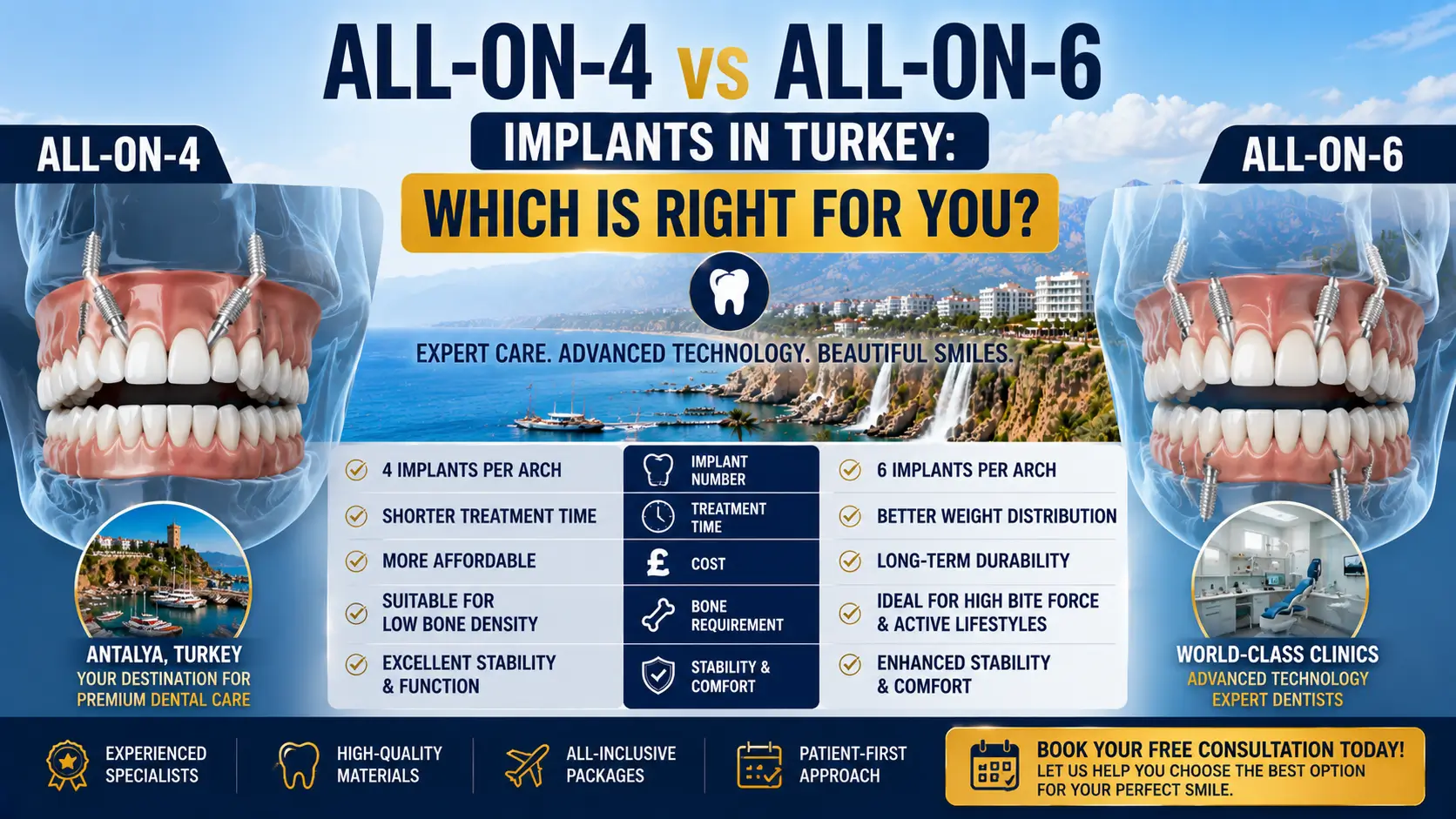
| If you’ve been told you need full-mouth implants, the next question is always the same: All-on-4 or All-on-6? Here’s the honest answer — and why the price difference is only part of the story. |
Losing most or all of your teeth — whether through decay, gum disease, or years of difficulty accessing dental care — is one of the most significant things that can happen to your confidence, your ability to eat properly, and your sense of self. Full-arch implant treatment exists to give that back. Not a partial fix, not a compromise. A complete set of fixed, permanent teeth that function and feel like your own.
The two main options — All-on-4 and All-on-6 — are both excellent solutions in the right circumstances. They differ in the number of implants used, the bone support they provide, and the clinical situations in which each is appropriate. This guide explains both clearly, compares them honestly, and tells you which questions to ask at your assessment to get the right recommendation for your specific case.
What Is Full-Arch Implant Treatment?
All-on-4 and All-on-6 are both techniques for replacing an entire arch of teeth — upper, lower, or both — using a fixed prosthetic bridge supported by implants placed directly into the jawbone. Unlike traditional dentures, the bridge does not come in and out. It is permanently fixed, cleaned like natural teeth, and does not rely on adhesives, clasps or suction.
The bridge itself is typically made from a high-strength material (usually zirconia or acrylic-over-titanium for the immediate temporary bridge) and is designed to look and function as naturally as possible. For patients who have been living with failing teeth, ill-fitting dentures, or significant tooth loss for months or years, the transformation is often genuinely life-changing.
| £14K–22KAll-on-4 cost per arch at UK private clinics | from £3,500All-on-4 per arch at Our Dentist Abroad, Antalya | 1 daySurgical procedure time for full-arch placement | 32 yrsOur Dentist Abroad placing full-arch cases in Lara |
How All-on-4 Works
All-on-4 places four implants per arch — two upright at the front and two angled at 45 degrees towards the back of the jaw. The angled rear implants are a deliberate engineering solution: they allow the rear of the bridge to be supported without implants being placed in areas of the jaw where bone density is often lower. This is the key clinical advantage of All-on-4 — it works well in patients with moderate bone loss who might otherwise need extensive bone grafting before implant placement.
All four implants are placed in a single surgical session, and a temporary fixed bridge is fitted on the same day. You leave the clinic with teeth. The permanent bridge is fitted at a second visit, after osseointegration is complete (three to six months later).
| All-on-4 — advantages | All-on-4 — limitations |
| Fewer implants means lower overall costAngled implants work in areas of lower bone density — often no bone graft neededFull-arch restoration completed in a single surgical dayTemporary fixed bridge fitted immediately — you leave with teethWell-established technique with a strong clinical evidence base (15+ years of data)Both arches can be treated simultaneously if needed | Four implants provide slightly less overall support than six, particularly under heavy chewing loadLess suited to patients with significant posterior bone loss where angled implants alone aren’t sufficientIf one implant fails, the impact on the bridge is proportionally greaterNot recommended for patients who grind heavily without a night guard planThe posterior cantilever (overhanging section) requires careful occlusal management |
How All-on-6 Works
All-on-6 adds two additional implants to the All-on-4 configuration — typically placed in the posterior (rear) jaw region, all at upright angles. The two extra implants provide additional support at the back of the arch, which is where the majority of chewing force is concentrated. The result is a bridge that is more evenly loaded and typically more stable under heavy use.
All-on-6 is particularly well-suited to patients with good posterior bone volume — where there’s sufficient bone to place the additional implants uprightly — and to those with a stronger bite, larger jaw dimensions, or a history of bruxism (teeth grinding). It’s also the preferred option for patients who want the maximum long-term security from their full-arch restoration.
| All-on-6 — advantages | All-on-6 — limitations |
| Greater bone-to-implant contact means better distribution of chewing forcesMore stable under heavy load — better suited to patients with strong bite forceSix points of support reduce stress on individual implants and the bridgePreferred for patients with good posterior bone who want maximum longevityReduced posterior cantilever means less mechanical risk to the prosthesis over timeBetter option if upper and lower arches have different bone conditions | Higher cost than All-on-4 (two additional implants and associated surgical time)Requires adequate posterior bone volume — not suitable if bone density is low at the backMay require bone grafting in some cases to achieve sufficient posterior supportSlightly longer surgical procedure than All-on-4 |
Which One Is Right for You? The Clinical Decision
The honest answer is that neither option is universally superior. The right choice for you depends on your specific jaw anatomy, bone density, bite force, overall health, and treatment goals. Here’s a practical decision framework:
| Clinical factor | Suggests All-on-4 | Suggests All-on-6 |
| Posterior bone density | Moderate to low — angled implants avoid graft need | Good — sufficient for upright posterior implants |
| Bite force | Average chewing load | Heavy bite or history of bruxism |
| Jaw anatomy | Narrower or shorter jaw | Wider jaw with adequate posterior bone width |
| Cost priority | Minimising overall treatment cost | Maximising long-term stability and longevity |
| Health considerations | Patients where minimising surgical time is preferable | Patients in good health who want the most robust solution |
| Previous denture wearers | Either option can work — depends on bone assessment | Either option — bone assessment determines the final choice |
| The decision between All-on-4 and All-on-6 should always be based on a 3D CBCT scan — not on patient preference alone, and not on cost. Any clinic that recommends one option without reviewing your 3D imaging is not giving you the advice you need. |
Price Comparison: UK vs Antalya
| Treatment | UK (private) | Antalya | Saving |
| All-on-4 (single arch) | £14,000–£18,000 | from £3,500 | up to £14,500 |
| All-on-4 (both arches) | £28,000–£36,000 | from £6,500 | up to £29,500 |
| All-on-6 (single arch) | £18,000–£24,000 | from £4,800 | up to £19,200 |
| All-on-6 (both arches) | £36,000–£48,000 | from £9,000 | up to £39,000 |
| Temporary bridge (day of surgery) | Often included | Included | — |
| 3D CBCT scan | Often charged separately | Included | — |
All Antalya prices are inclusive of the implant fixtures, abutments, temporary bridge (fitted on the day of surgery), permanent zirconia bridge, 3D CBCT scan, and all clinical appointments. There are no hidden charges. A full written, itemised quote in sterling is provided before you agree to anything.
The Full-Arch Process at Our Dentist Abroad
Full-arch implant treatment requires two visits to Antalya, with a healing period of three to six months in between. Here’s how it works:
| Visit 1Day 1–2 | Full 3D CBCT scan and clinical assessment. Implant option (All-on-4 or All-on-6) confirmed based on imaging. Written treatment plan and quote finalised. |
| Visit 1Day 3 | Full-arch implant placement surgery — all implants placed in a single procedure under local anaesthetic. Temporary fixed bridge fitted on the same day. You leave with a full set of fixed teeth. |
| Visit 1Day 4–5 | Post-surgical review. Bite check on temporary bridge. Any discomfort addressed. Transfer home. |
| Healing period | 3–6 months at home in the UK. Proactive follow-up at 3 months via video call. Temporary bridge worn throughout. |
| Visit 2Day 1–2 | 3D scan confirming osseointegration. Impressions for permanent bridge. Shade and shape approval. |
| Visit 2Day 3 | Permanent zirconia bridge fitted. Full bite assessment. Implant passports issued. Documentation provided for UK dentist. Transfer home. |
A Real Case
“I’d been wearing a full upper denture for eleven years. It was uncomfortable, it moved when I ate, and I’d more or less stopped smiling in photographs. My dentist in Leeds told me I’d need bone grafting first — that was going to cost £4,000 before they even started on the implants. At Our Dentist Abroad, the 3D scan showed I had enough bone for All-on-4 without grafting. I had the surgery, came home, and went back six months later for the permanent bridge. I can eat properly, I smile without thinking about it, and I genuinely wish I’d done it ten years earlier.” — Patient from Leeds, 2023
Frequently Asked Questions
Can I eat normally straight after surgery?
You’ll leave the clinic on the day of surgery with a temporary fixed bridge — so yes, you can eat. However, for the first few weeks whilst osseointegration is underway, we recommend a soft diet. Hard, crunchy or chewy foods should be avoided during the healing period to protect the implants. Once the permanent bridge is fitted, most patients eat comfortably without any significant restrictions.
How long will the permanent bridge last?
The titanium implants themselves should last a lifetime with proper care. The zirconia bridge typically lasts 15–25 years before needing attention. The longevity depends significantly on oral hygiene, regular check-ups, and whether you grind your teeth (for which we recommend a night guard). We provide full maintenance guidance before you leave Antalya.
Will I need bone grafting?
This can only be assessed properly from a 3D CBCT scan. In many cases, the angled posterior implants in All-on-4 eliminate the need for bone grafting — this is one of the technique’s principal advantages. Where grafting is needed, it is usually performed at the same appointment as implant placement. We confirm this in your written treatment plan before you travel.
Can both arches be treated at the same time?
Yes. Treating both arches in the same surgical session is possible and is the preferred approach for most patients who need full-mouth rehabilitation — it minimises total visits to Antalya and means the healing period for both arches runs concurrently. We assess the clinical suitability of simultaneous arch treatment from your 3D imaging.
How do I know which option is right for me before I travel?
Send us your most recent X-rays and photographs via WhatsApp or email. We’ll review the images and give you a provisional recommendation — All-on-4 or All-on-6 — along with a written, itemised quote. The definitive recommendation is confirmed from your 3D CBCT scan on arrival, but the provisional assessment is usually accurate and gives you a reliable basis for planning your trip.
| Find out which option is right for you — book a free assessment with X-ray review and receive a personalised recommendation within 24 hours. |