



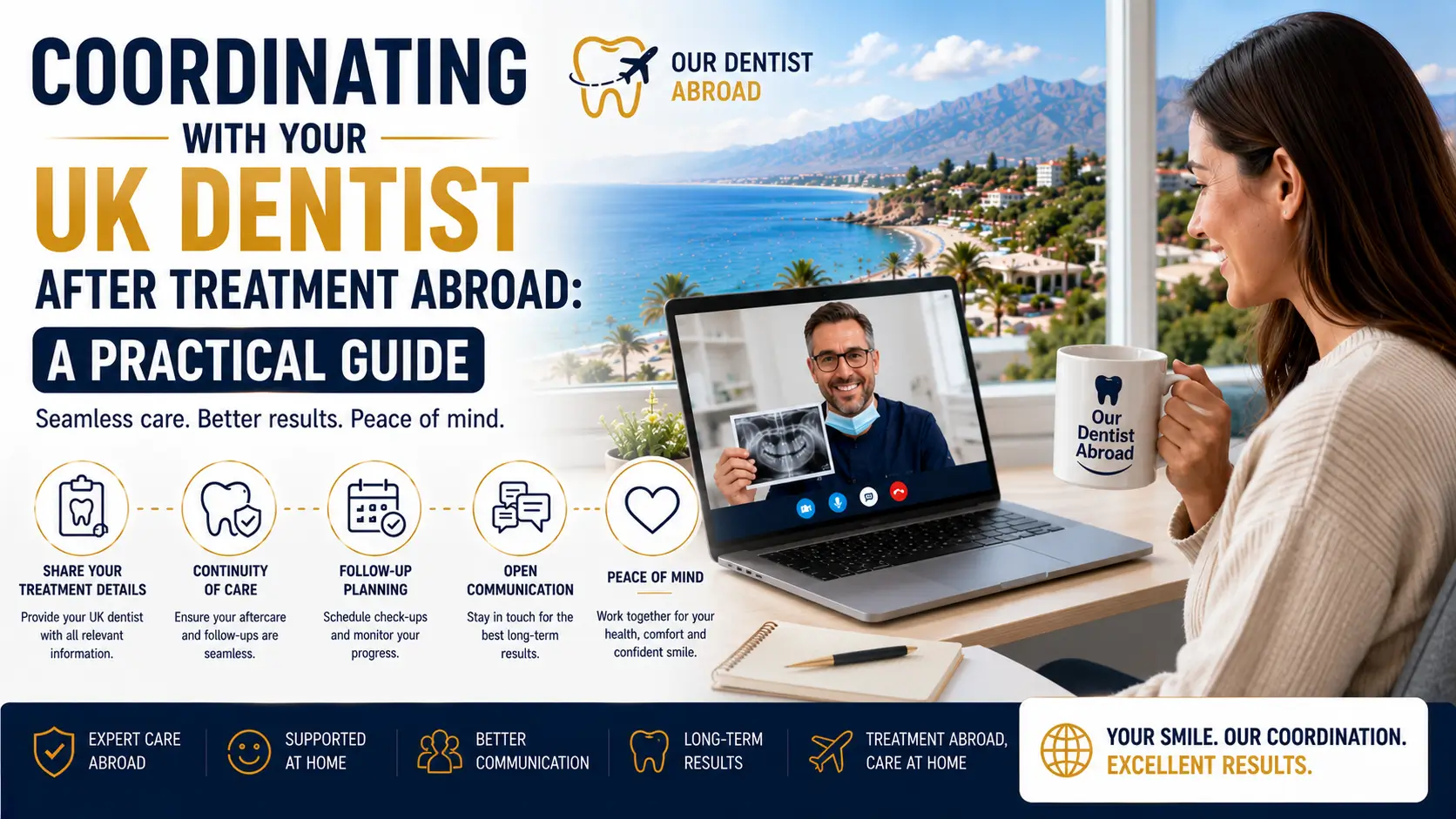
| After dental implant or veneer treatment in Turkey, UK patients should give their NHS or private dentist a written treatment summary and implant passport on their return. UK dentists are legally obligated to provide routine monitoring and emergency care regardless of where previous treatment was performed. Our Dentist Abroad provides full clinical documentation before departure and remains available for remote follow-up indefinitely. |
You’ve just landed at Heathrow. Your smile is new, your paperwork is in your bag, and somewhere in the back of your mind is a question you’ve been meaning to sort out: what do you actually say to your NHS dentist?
It’s a reasonable thing to wonder. The relationship between treatment abroad and UK dental follow-up is genuinely misunderstood — both by patients who assume their NHS dentist will refuse to engage, and by patients who assume the UK dentist will seamlessly take over all responsibility. Neither is accurate. This guide explains precisely what happens when you return to the UK, what your dentist can and cannot do, and how Our Dentist Abroad stays involved in your care long after your flight home.
The Core Principle: Documentation Makes Everything Simple
The most common reason a UK dentist is reluctant to engage with overseas dental work is not ideological — it’s practical. They cannot safely monitor or continue care for treatment they have no clinical record of. Brand of implant, batch number, placement protocol, materials used in veneers, post-operative notes — without these, they’re working blind.
This is why the documents we provide before you leave Antalya are not administrative formalities. They are clinical tools, designed specifically for your UK dentist. When they have everything they need, the conversation is straightforward. Most UK dentists — NHS and private — receive these documents professionally and without difficulty.
What You Take Home from Our Dentist Abroad
Before you leave for the airport on your final day, your patient coordinator gives you a physical and digital documentation package containing the following:
| Document | What it contains and why your UK dentist needs it |
| Written Treatment Summary | A complete record of every procedure performed — preparation details, materials used, clinical notes and observations. Written in English and formatted for a UK dental practice to file directly. Covers implant fixtures, crown specifications, veneer materials, any bone graft details, and post-operative findings. |
| Implant Passport (implant patients) | The single most important document for implant follow-up. Contains the exact brand (e.g. Straumann, Nobel Biocare, Osstem), specific model, batch number, placement date, insertion torque, and crown specifications. Required by any dentist attempting to work on or around the implant in future. |
| Pre- and Post-Treatment X-Rays | Digital radiographic records from before and after treatment. Available in standard dental imaging formats. Your UK dentist can request these directly from us if needed — we hold them indefinitely. |
| Aftercare Protocol | A written clinical guide specifying what normal healing looks like at each stage, what symptoms to monitor, when to contact us versus your UK dentist, and the schedule for routine check-ups. |
| Guarantee Documentation | The written terms of your treatment guarantee — what is covered, for how long, the exclusions, and the procedure for raising a claim. Provided before treatment begins, restated in the departure pack. |
| Direct Contact Details | Your patient coordinator’s WhatsApp and email. Your UK dentist can contact us directly if they have clinical questions about your treatment. Most don’t need to — the treatment summary covers it — but the option is there. |
Your First Appointment Back with Your UK Dentist
There is no formal process for registering overseas dental work with your UK dentist — you simply attend your next routine appointment (or book one if it’s overdue) and hand over the documentation. Here is a practical script for that conversation:
| “I had dental treatment in Turkey last [month]. I have the full clinical documentation here — a written treatment summary, implant passport, and aftercare protocol. I’d like to add it to my records and arrange a routine check at my next appointment.” |
That is all that is required. You are not asking the dentist to take clinical responsibility for work they did not perform. You are asking them to do what they already do at every appointment: examine your teeth, check gum health, review the fit and condition of restorations, and flag anything that needs attention.
What Your UK Dentist Can Do
A UK NHS or private dentist can legally and professionally do the following for patients who have had treatment abroad:
1. Routine clinical monitoring — checking the condition of implant crowns, veneer margins, gum health around implants, and bite at any standard appointment.
2. Periodic X-rays of the implant site — to monitor bone levels around the implant over time. This is standard implant maintenance and requires no special authorisation.
3. Scale and clean around veneers and implants — routine hygiene appointments should continue exactly as before. The treatment does not change this.
4. Emergency care — if you experience pain, swelling or acute problems locally, your UK dentist can assess and treat in the same way they would for any other dental issue.
5. Minor occlusal adjustments — if the bite feels slightly off after you return, any competent general dentist can make minor adjustments to the crown or veneer. This is standard clinical work that does not affect the guarantee.
6. Referral to a specialist if needed — if they identify something that requires specialist assessment (periodontist, oral surgeon), they can refer you through normal channels.
What Your UK Dentist Cannot Do (and Why That’s Fine)
There are three things your UK dentist is not able to do — and it’s worth being clear about these so expectations are realistic on both sides.
| Cannot do | Reason | What to do instead |
| Take clinical responsibility for the original treatment | They were not present and did not perform the work — professional liability cannot be transferred | Our Dentist Abroad retains responsibility for the treatment we performed |
| Override or issue a UK guarantee for overseas work | Guarantees are issued by the treating practice — they cannot be extended or replaced by a third party | Your written guarantee from Our Dentist Abroad covers the treatment — contact us directly for any guarantee claim |
| Access our clinical notes without your providing them | Data protection and the lack of a shared clinical system means there is no direct record transfer | The treatment summary you bring home closes this gap entirely — once they have it, they have everything they need |
Our Ongoing Follow-Up After You Return
The care relationship with Our Dentist Abroad does not end at Antalya Airport. This is what our standard post-treatment engagement looks like for every patient:
| Timing | What we do |
| Immediately on return | Your patient coordinator confirms safe arrival and answers any immediate questions |
| 3 months post-implant surgery | Proactive check-in call — your coordinator reviews your recovery, asks about symptoms, discusses the implant site |
| 6 months post-implant surgery | Second follow-up — coincides with the pre-Visit 2 assessment window for most patients |
| At any point (all patients) | WhatsApp and email available indefinitely — all messages responded to within 24 hours |
| On request | Video consultation with the treating dentist — available throughout the healing period and beyond |
| Annually (implant patients) | Annual follow-up call for the life of the implant |
The proactive follow-up model exists because passive aftercare — “contact us if you have a problem” — places the burden on the patient to recognise and report issues that they may not have the clinical knowledge to identify. Our coordinators are experienced in spotting early indicators of implant healing concerns from patient descriptions and photographs. In most cases, the three-month call is a reassuring confirmation that everything is progressing normally. Occasionally, it catches something early that benefits from prompt attention.
What If My NHS Dentist Won’t Engage with Overseas Work?
This is rare but does occasionally happen. When it does, it usually has one of three causes: unfamiliarity with the process, concern about liability, or a practice policy. Here is how to approach each:
Unfamiliarity with the process
Show them the treatment summary and implant passport. In many cases, a dentist who initially hesitates changes their position once they see properly formatted clinical documentation. The hesitation is typically about the unknown — the documentation resolves it.
Concern about liability
Clarify that you are not asking them to accept responsibility for the original treatment. You are asking them to do what they already do for every patient: monitor, maintain and treat. The treatment abroad doesn’t change that clinical relationship — it just adds context to the record.
Practice policy
A small number of NHS practices have policies against engaging with overseas dental work. If yours does, a private dentist will monitor your treatment without difficulty. Alternatively, contact us: for patients near Nottingham, we can arrange a face-to-face UK appointment at our office. For others, we can advise on how to find appropriate monitoring.
| Your treatment summary, implant passport and aftercare protocol are designed to make your UK dentist’s job easier, not harder. In 32 years of treating British patients, the vast majority of NHS dentist interactions we hear about are professional and straightforward. |
How to Get Your X-Rays from Antalya
Your pre- and post-treatment radiographic records are held by Our Dentist Abroad. To request them:
1. Contact your patient coordinator by WhatsApp or email and request your X-rays.
2. Specify the format — JPEG/PNG for general viewing, DICOM for clinical software.
3. Specify whether they should be sent to you directly or to your UK dentist.
4. Allow 24–48 hours for processing and delivery.
There is no charge for this. We hold imaging records indefinitely and provide them on request to patients and their treating clinicians.
Frequently Asked Questions
Will my NHS dentist know what to do with the implant passport?
Yes. The implant passport format is standard across dental practices internationally. It contains the brand name, model designation, batch number and placement date — the same information any implant passport contains, whether the implant was placed in London or Antalya. Your UK dentist will be familiar with the format.
Do I need to tell my NHS dentist I had treatment abroad?
Yes — legally and for patient safety. Your dentist needs a complete and accurate dental history to provide safe ongoing care. There is nothing to be concerned about in disclosing treatment abroad; it is increasingly common and the documentation we provide makes the conversation simple. Concealing it risks your dentist making clinical decisions based on incomplete information.
What if a veneer chips or comes off after I return to the UK?
Contact your patient coordinator at Our Dentist Abroad first — before going to a UK dentist for repair. We will assess the situation remotely and determine whether it falls under your guarantee. If it does, we arrange your return to Antalya and repair it at no charge. If you have a local dentist make the repair first without consulting us, the guarantee situation becomes complicated. Always contact us first.
Can I claim on my dental insurance for treatment received in Turkey?
This depends entirely on your specific insurance policy. Some UK dental insurance policies cover emergency treatment or complications arising from overseas dental work; most do not cover the original treatment abroad. Review your policy terms or contact your insurer directly. Travel insurance with medical cover may include dental emergencies — check your policy before you travel.
What is the Nottingham office for?
Our Nottingham office provides face-to-face UK contact for patients who prefer or need an in-person meeting. It is not a treatment facility, but it is a real staffed office where you can discuss concerns, collect documentation, or speak with a UK-based coordinator. If you are near Nottingham and would find this useful, contact your patient coordinator to arrange an appointment.
How long will Our Dentist Abroad remain available for aftercare support?
Indefinitely. There is no time limit on aftercare support. Your patient coordinator remains contactable by WhatsApp and email for as long as you need — whether that is six weeks after treatment or six years. For implant patients, we maintain annual follow-up contact for the life of the implant. We do not consider aftercare to have an expiry date.
| Back in the UK with questions about your treatment? Message your patient coordinator on WhatsApp — we respond within 24 hours. |