



If you’re missing a single tooth, the two most common solutions you’ll come across are a dental implant and a dental bridge. Both replace the visible gap effectively, and both have a long track record of success, but they work in genuinely different ways — and that difference matters a great deal for your other teeth, your long-term maintenance, and your overall cost over time. This guide compares the two options directly, so you can make a properly informed decision rather than choosing based on price alone.
Two Ways to Replace a Single Missing Tooth
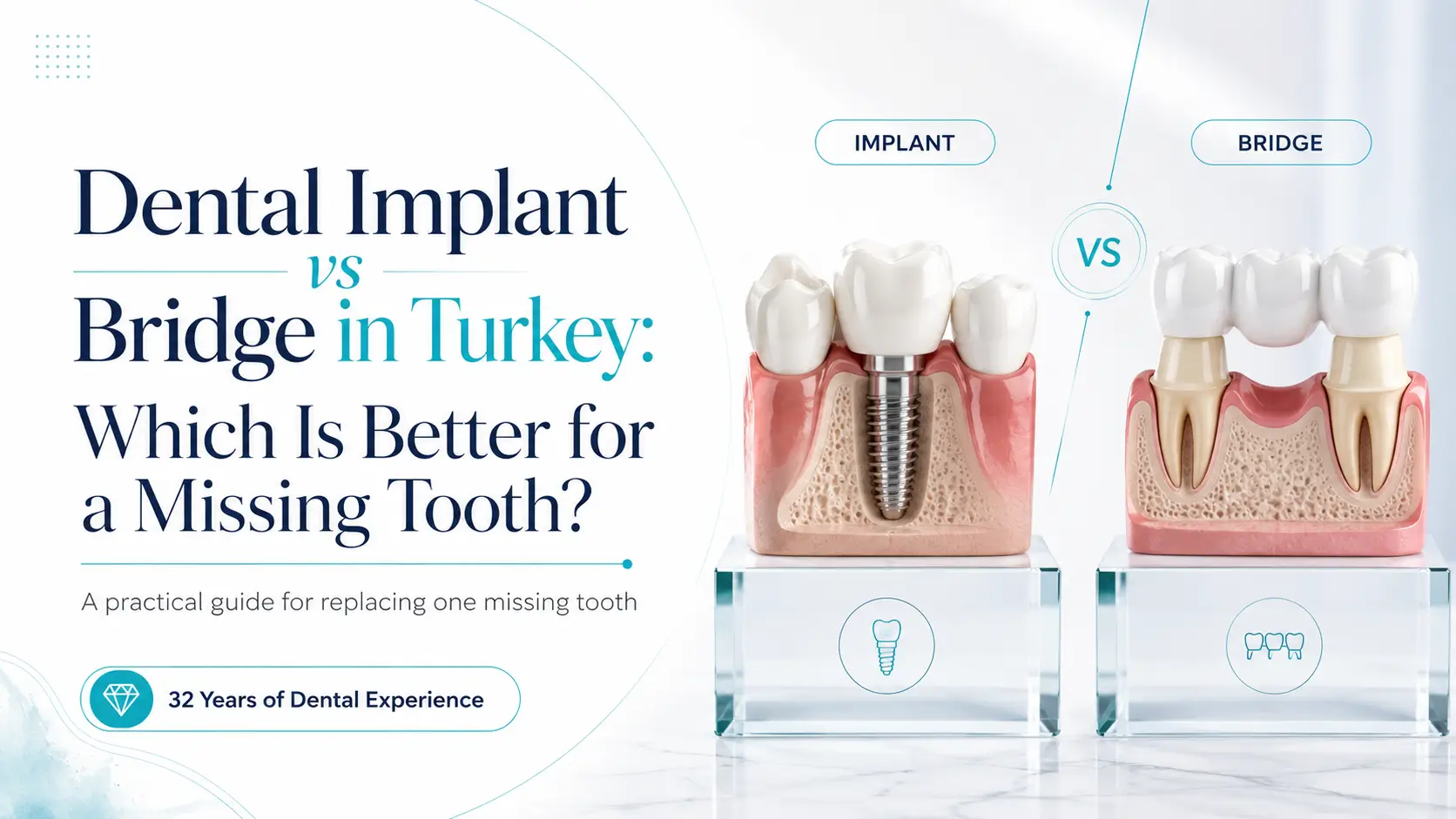
A dental bridge replaces a missing tooth by anchoring a false tooth to the natural teeth on either side of the gap. A dental implant replaces the missing tooth’s root directly with a titanium post placed into the jawbone, topped with its own independent crown. The core difference is straightforward: a bridge relies on your existing teeth for support, while an implant stands entirely on its own.
How a Dental Bridge Works
To fit a bridge, the two teeth adjacent to the gap are shaped down — similar to preparing a tooth for a crown — so that crowns can be placed over them. These two crowns are then joined to a false tooth in the middle, forming a single connected unit that spans the gap. A well-made bridge can look extremely natural and typically takes only one or two visits to complete, since there’s no healing period required before it’s fitted.
The trade-off is that it requires permanently altering two healthy teeth that may not have had any problem before, purely so they can support the bridge. Once those teeth are shaped down for crowns, that change can’t be undone, even if you later decide you’d have preferred a different option.
How a Dental Implant Works
An implant is placed directly into the bone where the tooth root used to be, and is left to heal and fuse with the bone over a period of two to four months before a crown is attached. This means it doesn’t rely on the neighbouring teeth for support at all — they’re left completely untouched. The trade-off is a longer overall timeline, usually across two visits to Turkey with a healing gap in between, and a procedure that involves placing something into the jawbone rather than working only on existing teeth.
Protecting Your Neighbouring Teeth: The Biggest Difference
This is usually the single most important factor in the decision. If the teeth either side of your gap are already healthy, with no fillings, cracks or previous root canal work, most dentists will recommend an implant specifically to avoid cutting into them unnecessarily. Once a healthy tooth is shaped down for a bridge crown, it’s permanently altered and will need a crown for the rest of its life, even though nothing was originally wrong with it.
On the other hand, if the neighbouring teeth already have large fillings or existing crowns — meaning they’ll need crown-level protection at some point regardless — a bridge can make practical sense, since it addresses several teeth’s needs in one combined treatment rather than treating them separately.
Comparing Cost: Upfront vs Long-Term
A dental bridge is often somewhat less expensive upfront than a single implant, since it doesn’t involve a surgical placement stage or an extended healing period. However, the long-term cost picture can look different. A bridge typically needs replacing roughly every ten to fifteen years as the supporting crowns and the underlying teeth age, and if one of the supporting teeth ever fails, the entire bridge structure may need to be redone. An implant, once successfully integrated, is designed to function as a long-term, standalone replacement, with the main future cost being occasional crown replacement rather than replacing the entire structure.
When comparing quotes, it’s worth asking each clinic for a full cost breakdown covering the components involved — for a bridge, this means the crowns on both supporting teeth plus the false tooth; for an implant, the fixture, abutment and crown — rather than comparing two very different treatments on a single headline number.
Comparing Timeline: How Long Each Takes
A bridge is generally the faster route to a finished result, since there’s no biological healing period required — most bridge cases are completed within one to two visits over a matter of days. An implant requires two separate visits with a healing gap of two to four months in between, which suits patients who can plan around two shorter trips rather than needing everything finished on a single visit.
- Bridge: typically completed in one to two visits, often within the same week or two.
- Implant: typically two visits, spaced two to four months apart to allow proper healing.
If your travel plans only allow for a single trip to Turkey, that practical constraint may reasonably steer the decision toward a bridge, even where an implant would otherwise be the preferred long-term option.
Long-Term Maintenance and Lifespan
Both options need consistent daily hygiene, but the specifics differ. A bridge requires special floss or an interdental brush designed to clean underneath the connected false tooth, since ordinary flossing can’t reach that area, and any decay developing under a bridge can be harder to detect early. An implant is cleaned much like a natural tooth, with additional attention paid to the gumline where the implant meets soft tissue, and because it doesn’t rely on neighbouring teeth, any future problem is isolated to that single tooth rather than affecting a connected structure.
With proper care, a bridge commonly lasts ten to fifteen years before it needs replacing, while a well-integrated implant frequently lasts several decades, with many patients keeping the same implant for the rest of their life.
What Happens If a Bridge or Implant Ever Fails
It’s worth thinking through the worst-case scenario for each option, since it affects the long-term risk you’re taking on. If a bridge fails — commonly because one of the supporting teeth develops decay or a crack under its crown — the entire bridge usually needs to be remade, which can mean re-treating both supporting teeth again. If an implant fails, which is uncommon when it’s been properly planned and placed, the issue is isolated to that single implant and doesn’t affect any of your natural teeth, since none of them were altered to support it in the first place.
A Straightforward Way to Think About the Choice
If you strip away cost and travel logistics for a moment, the underlying clinical question is simple: would you rather protect two healthy teeth and accept a longer treatment timeline, or accept altering two healthy teeth in exchange for a faster, single-visit result? Neither answer is wrong — it depends on what you value most for your specific situation, and a good dentist will lay out both paths clearly rather than steering you toward whichever is quicker or more profitable for the clinic.
Who Is a Better Candidate for Each Option
An implant is usually the stronger recommendation if your neighbouring teeth are healthy and undamaged, if you have adequate bone at the site of the missing tooth, and if you’re able to plan two shorter trips around a healing period. A bridge tends to make more sense if the adjacent teeth already need crowns regardless, if you have insufficient bone for an implant and would rather avoid a bone graft, or if your travel schedule genuinely only allows for one visit. Medical factors such as uncontrolled diabetes or certain bone conditions can also affect implant suitability and should always be discussed openly during your assessment rather than after treatment has already begun.
With 32 years of dental experience weighing these trade-offs across thousands of individual cases, the right recommendation always comes down to your specific mouth and circumstances — not a fixed rule that one option is universally better than the other.
Questions Worth Asking Before You Decide
Whichever way you’re leaning, it’s worth asking your dentist to explain, in your specific case, why they’re recommending one option over the other — not just which is cheaper or faster. Ask what condition your neighbouring teeth are actually in, what your bone level looks like at the implant site if that’s being considered, and what the realistic lifespan of each option would be for someone in your situation. A clear, specific answer to each of these is a good sign you’re getting a considered recommendation rather than a default answer.
Getting a Personalised Recommendation
If you’re deciding between a bridge and an implant, send us a recent X-ray if you have one, along with details of when the tooth was lost and the condition of the teeth either side of the gap. We’ll give you a clear, honest recommendation based on your specific case, along with a realistic timeline and cost breakdown for whichever option genuinely suits you best.