



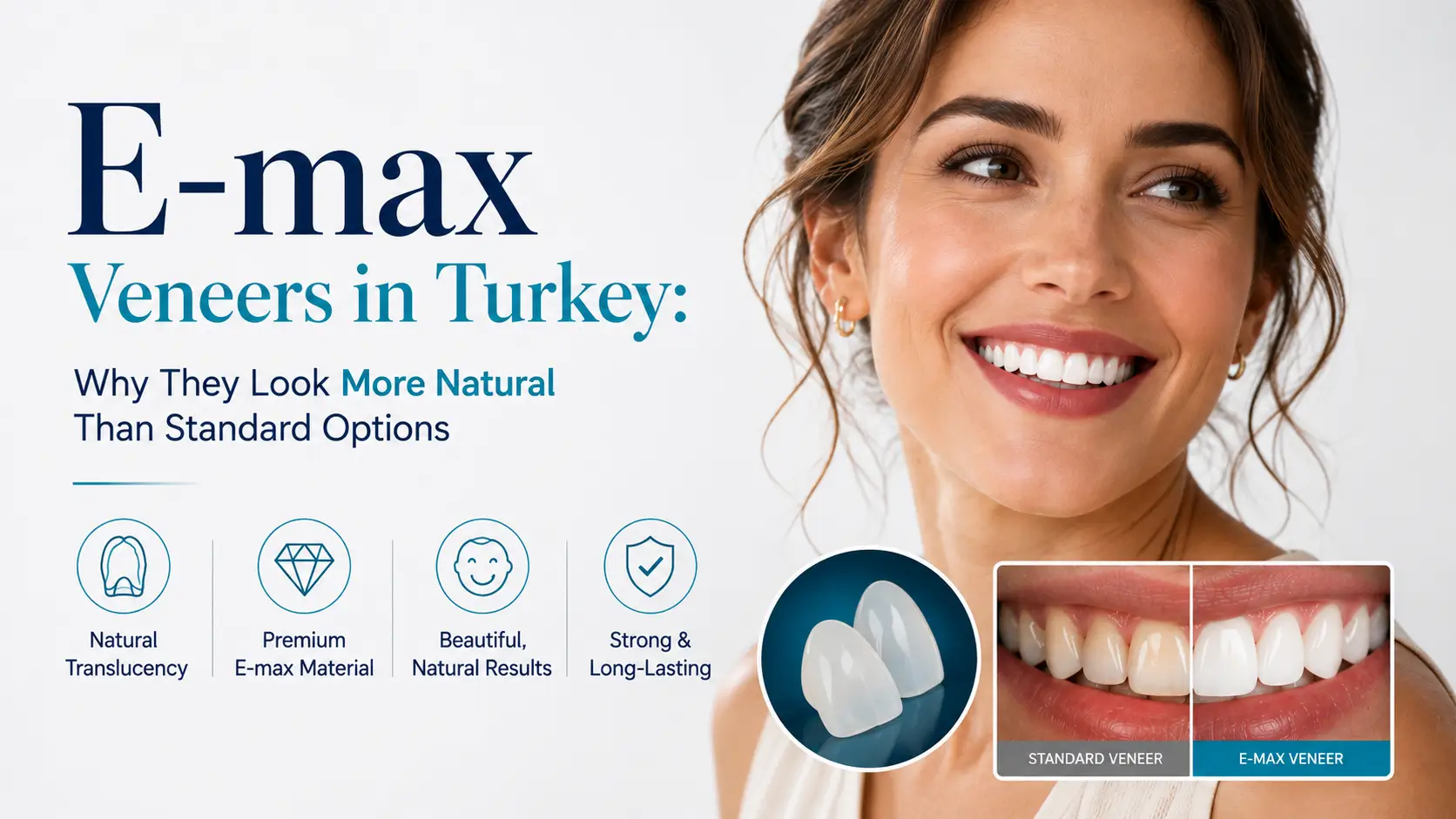
Anyone comparing veneer materials for long enough eventually runs into the same name over and over: E-max. It’s become something of a go-to recommendation for patients who specifically want a natural-looking result rather than the flat, obviously-fake appearance often associated with lower-grade veneers. But what actually makes E-max different, and is it the right choice for your case? This guide explains the material itself, why it behaves the way it does in your mouth, who tends to benefit most from it, and what it realistically costs in Turkey compared with other options.
This isn’t a blanket recommendation that E-max is automatically right for everyone — it’s a breakdown of what the material genuinely does well, so you can judge for yourself whether it matches what you’re looking for.
What Makes E-max Different From Standard Veneer Materials
E-max is a lithium disilicate glass-ceramic, a material engineered specifically to combine strength with a high degree of translucency — a combination that’s genuinely difficult to achieve in dental ceramics, since materials that are more translucent are often more brittle, and materials that are stronger are often more opaque. E-max was developed to sit in a sweet spot between the two, which is exactly why it’s become one of the most widely used premium veneer materials over the past two decades.
Standard, older-generation veneer materials — some feldspathic ceramics and pressed composites in particular — tend to be more opaque, which limits how they interact with light. This isn’t necessarily a flaw in every case, but it’s a major factor in why some veneer results look noticeably artificial, especially on front teeth viewed in daylight or camera flash.
Light Transmission: The Real Reason E-max Looks Natural
Natural tooth enamel isn’t a flat, solid colour — it’s semi-translucent, allowing light to penetrate partway into the tooth and reflect back from the dentin layer underneath, which is what gives real teeth their subtle depth and shine. E-max is specifically valued because it mimics this behaviour far more closely than opaque materials do. Light passes into the veneer and interacts with the layers beneath it in a way that reads as “real” to the eye, rather than sitting on the surface and reflecting in a flat, uniform way.
This is the single biggest reason E-max veneers are associated with a natural result, and it’s also why shade-matching with E-max tends to look more convincing in a range of lighting conditions — daylight, indoor lighting and camera flash — rather than looking fine in one setting and obviously artificial in another.
Strength and Thinness: A Rare Combination
Beyond aesthetics, E-max also has genuinely strong mechanical properties for a ceramic material, which allows it to be milled into thinner veneers than many alternative options while still withstanding normal biting forces. This matters directly for your natural teeth: thinner veneers generally require less removal of your original tooth structure during preparation, which is a meaningful advantage if preserving as much of your natural tooth as possible is a priority for you.
Who Is a Good Candidate for E-max Veneers
E-max tends to be recommended for patients who want to address cosmetic concerns — discolouration, minor gaps, uneven shape or wear — on teeth that are otherwise structurally healthy, since veneers work by bonding to existing enamel rather than replacing lost tooth structure entirely. It’s a particularly strong option for front teeth, where the translucency advantage is most visible and most valued. Patients with significant grinding habits or very limited remaining enamel may be better suited to a different material or approach, which is exactly why a proper clinical assessment matters more than picking a material based on marketing alone.
The E-max Veneer Process Step by Step
The process typically begins with photographs, a shade consultation, and often a digital or physical mock-up so you can preview the planned shape and colour before any permanent preparation happens. Minimal preparation of the tooth surface follows, an impression or digital scan is taken, and the veneers are milled and finished in a dental laboratory before being bonded permanently onto your teeth. Depending on the clinic’s workflow, this can be completed in a single visit lasting several days, or occasionally over two shorter visits if a trial-fit stage is included.
How Much Do E-max Veneers Cost in Turkey?
E-max sits at the premium end of veneer materials, so it’s typically priced somewhat higher than standard composite veneers, though still considerably less than equivalent E-max treatment in the UK or Western Europe. The exact price depends on how many veneers you need, the complexity of your case, and the specific lab producing the veneers. When comparing quotes between clinics, it’s worth confirming explicitly that E-max is the material being quoted, since some listings use “premium veneers” as a vague marketing term without specifying the actual material underneath.
Comparing E-max to Other Veneer Materials
- Standard porcelain/feldspathic veneers: generally more opaque, often less expensive, can look flatter under bright light.
- Zirconia veneers: stronger and more opaque than E-max, sometimes preferred for patients needing extra durability over maximum translucency.
- Composite veneers: more affordable and reversible, but generally less durable and less natural in translucency than E-max.
None of these materials is universally “better” — E-max earns its reputation specifically in the natural-appearance category, which is why it’s so often recommended for front teeth where aesthetics matter most.
Caring for Your E-max Veneers Long Term
E-max veneers are cared for much like natural teeth — regular brushing, flossing and routine dental check-ups are usually all that’s needed. It’s worth avoiding using your front teeth to bite directly into very hard foods, such as ice or unshelled nuts, since while E-max is strong, no veneer material is indestructible. Patients who grind their teeth at night are generally advised to wear a protective night guard, which significantly extends the lifespan of any veneer material, E-max included.
How Long Do E-max Veneers Last
With good care, E-max veneers commonly last well over a decade, and many patients keep the same set for fifteen years or more before any replacement is needed. With 32 years of dental experience fitting a wide range of veneer materials, this longevity is consistently one of the strongest arguments for E-max among patients who want a long-term aesthetic solution rather than something that needs revisiting every few years.
E-max vs “Turkey Teeth”: Avoiding an Artificial Result
Much of the concern around “Turkey teeth” comes from cases where a lower-grade, more opaque material was used across an entire smile with little attention to individual shade or shape. E-max on its own doesn’t guarantee a natural result — the material still needs to be paired with careful shade selection, an accurate mock-up stage, and a dentist who takes face shape and lip line into account. What E-max does is remove one major variable from the equation: it gives your dentist a material capable of a genuinely natural look, rather than working against an inherently flat, opaque starting point.
Common Questions About E-max Veneers
Patients often ask whether E-max veneers can be whitened later — the honest answer is no, since the material doesn’t respond to whitening treatments the way natural enamel does, which is why shade selection at the planning stage matters so much. It’s also common to ask whether E-max works for slightly darker or heavily discoloured teeth underneath; in most cases it does, since the material and bonding technique can be adjusted to mask significant discolouration while still preserving a natural translucent finish.
What to Ask Your Clinic Before Booking
Before committing, it’s worth confirming which specific brand and generation of E-max material the clinic uses, since manufacturing quality and milling precision can vary between labs even when the material name is the same. It’s also worth asking to see real before-and-after photos of E-max cases, ideally in natural daylight rather than clinic lighting, and confirming whether a mock-up or trial-smile stage is included before your teeth are permanently prepared.
E-max for Crowns as Well as Veneers
It’s worth knowing that E-max isn’t limited to veneers — the same material is also widely used for crowns, particularly on front teeth where its translucency advantage matters just as much as it does for veneers. If your treatment plan involves a mix of crowns and veneers on visible teeth, using E-max consistently across both helps ensure the finished result blends evenly, rather than having subtly different materials sitting side by side in your smile.
Getting Started
If you’re considering veneers and want to know whether E-max is the right fit for your specific case, send us a few clear photos of your smile along with any concerns about shade, shape or previous dental work. We’ll give you an honest assessment of whether E-max suits your goals, along with a clear cost breakdown so you can compare it properly against other options.