



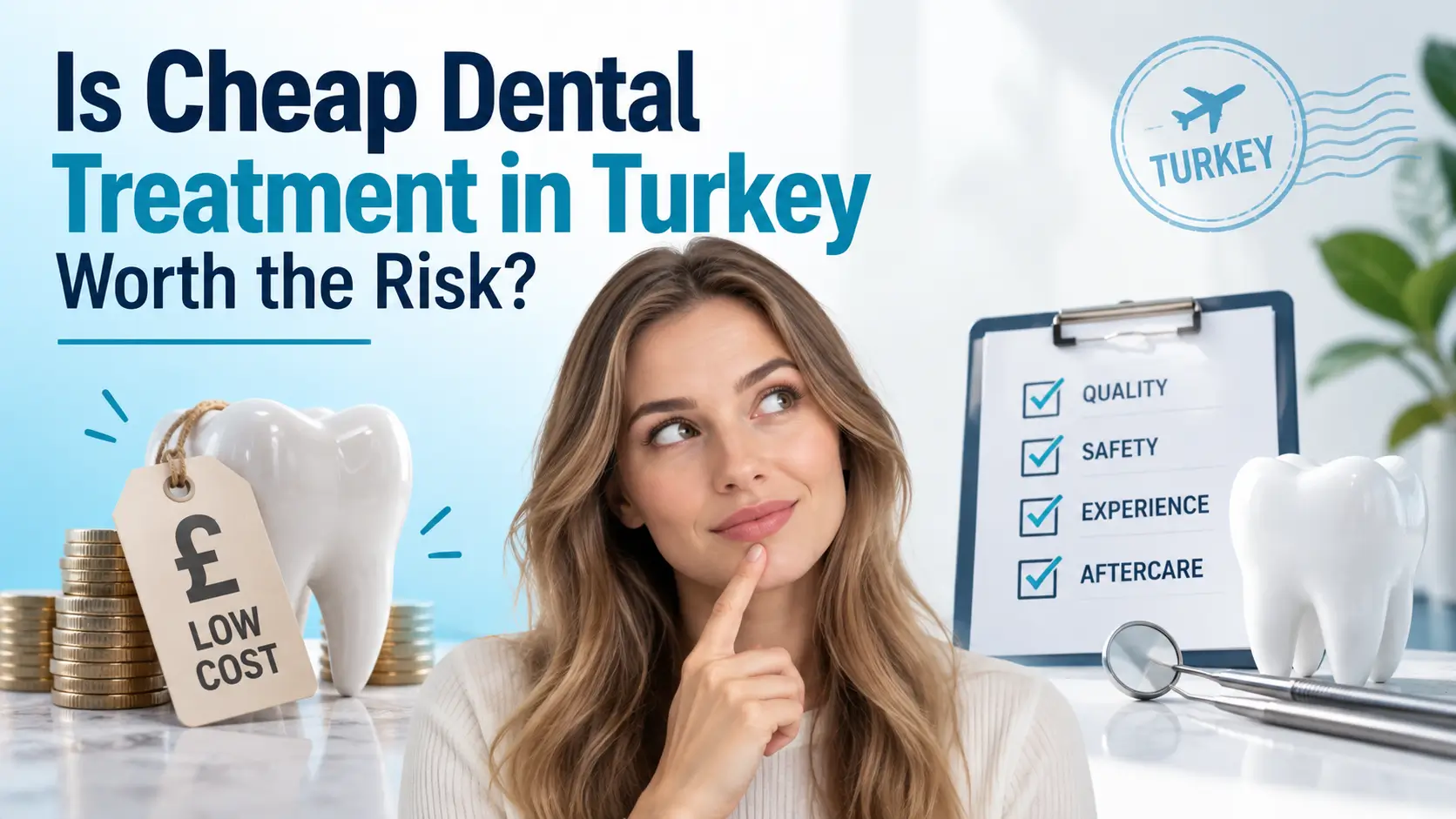
Search for dental treatment in Turkey and you’ll find prices spanning an enormous range, sometimes for what’s marketed as the exact same treatment. It’s natural to be drawn toward the lowest number on the page, particularly when you’re already saving significantly compared to UK prices. But an unusually low price is rarely just good luck — it usually reflects a specific cost being cut somewhere, and it’s worth understanding exactly where before you book. This guide looks honestly at what drives price differences, so you can judge a cheap quote on its merits rather than on the number alone.
Why Prices Vary So Much Between Clinics
Dental treatment pricing is built from several genuine cost components: the materials and brands used, the laboratory producing crowns or veneers, the experience level of the dentist, the clinic’s facilities and sterilisation standards, and the aftercare and support offered after you’ve flown home. A clinic offering a price significantly below the market average is, by definition, cutting cost somewhere in this list — the question worth asking isn’t whether they’re cutting a corner, but which one, and whether that corner matters for your specific treatment.
Where Material Costs Get Cut
Premium materials like E-max veneers or well-established implant brands cost considerably more than generic alternatives, and this difference shows up directly in the final price. Budget packages sometimes use unnamed or lesser-known implant systems and lower-grade ceramic materials that haven’t been through the same extensive clinical testing as established brands. This isn’t automatically a disaster, but it does mean a real trade-off in longevity, aesthetic quality, and the availability of replacement parts if something needs attention years from now — a trade-off you should be told about clearly, not left to discover later.
Where Laboratory Quality Gets Cut
Behind every crown, veneer or bridge is a dental laboratory doing the actual fabrication work, and lab quality varies enormously even within Turkey. Faster turnaround times and lower lab fees sometimes come at the cost of less precise fit, less careful shade matching, and less rigorous quality checking before a restoration leaves the lab. A well-fitted restoration from a meticulous lab and a poorly fitted one from a rushed lab can look similar in a quick glance but behave very differently over years of daily use.
Where Experience Gets Cut
Dentist experience is one of the hardest cost factors to see from a price list alone, but it’s one of the most consequential. A newly qualified dentist working with a lower-cost clinic will typically charge less than a dentist with decades of complex case experience, purely because their time and expertise haven’t yet reached that level of demand. For straightforward cases this may matter less; for complex full-mouth or multi-implant planning, the gap in outcome between an experienced and inexperienced clinician can be substantial, regardless of how good the materials being used are.
Where Aftercare Gets Cut
Aftercare support — a reachable contact after you’ve returned home, a clear warranty in writing, documentation like an implant passport, and a genuine plan for what happens if something goes wrong — costs a clinic time and infrastructure to maintain properly. Rock-bottom packages sometimes skip this almost entirely, leaving patients with no clear path forward if a problem arises months after returning to the UK. This is often the least visible cost saving at the point of booking, and the most painful one to discover missing later.
Signs a Price Is Genuinely Too Good to Be True
- No willingness to specify the exact brand or material being used, even when asked directly.
- Extremely short assessment before quoting, sometimes based on a single photo with no scan or X-ray.
- Pressure to book quickly with limited time to ask questions or compare against other clinics.
- No clear written warranty, or vague verbal reassurances instead of documented terms.
- Little to no mention of aftercare or what happens if you need follow-up once you’re home.
How to Judge a Cheap Quote Fairly
Not every lower-priced clinic is cutting corners in a way that matters for you — some genuinely operate with lower overheads or serve a higher volume of patients, allowing real savings without meaningfully compromising quality. The way to tell the difference is to ask the same specific questions of every clinic you’re comparing: which brand and material, which lab, how many years of experience with this exact procedure, what warranty is provided in writing, and what aftercare support looks like. A lower price with clear, confident answers to all of these is a genuinely different proposition from a lower price with vague or evasive answers.
The Real Cost of a Failed Cheap Treatment
It’s worth thinking through the financial logic as well as the clinical one. A significantly discounted treatment that fails early — a veneer that chips within a year, an implant that doesn’t integrate, a crown that never quite fits — often ends up costing more overall once you factor in the cost of redoing the work, any additional travel, and the time lost. With 32 years of dental experience seeing exactly this pattern play out for patients who later switch clinics after a disappointing first experience elsewhere, the cheapest quote upfront is not always the cheapest outcome over several years.
A Balanced Way to Think About Price
The goal isn’t to assume the most expensive clinic is automatically the best, or that every affordable clinic is cutting dangerous corners — reputable clinics across a wide price range exist in Turkey’s dental tourism industry. The goal is to treat price as one data point among several, and to insist on specific, verifiable answers about materials, experience, warranty and aftercare before deciding, rather than choosing based on the headline number alone.
Cheap Veneers and Cheap Implants: Different Risk Profiles
It’s worth noting that “cheap” carries different risks depending on the treatment. With veneers, a low price often means a more opaque, less durable material and less careful shade or shape planning — disappointing, but rarely dangerous. With implants, a very low price can sometimes mean a rushed assessment, insufficient bone evaluation, or an unfamiliar implant system with poor long-term data, any of which carries genuine clinical risk rather than just a cosmetic disappointment. This distinction is worth keeping in mind when weighing how much scrutiny a low price deserves for your specific treatment.
What “Turkey Teeth” Packages Often Get Wrong
The heavily discounted, high-volume “Turkey teeth” packages that circulate widely online often bundle a fixed number of veneers or crowns at a flat rate regardless of what each individual tooth actually needs. This template approach, covered in more detail in our guide to full mouth restoration, is where much of the criticism of cheap Turkish dental work originates — not from the country or the profession as a whole, but from a specific business model that prioritises volume and a fixed price point over individualised, tooth-by-tooth planning.
Questions That Cut Through Marketing
Rather than asking a clinic “is your price genuine value?” — a question any clinic will answer yes to — ask specific, checkable questions instead: which exact implant brand or veneer material is included at this price, what happens if a tooth needs additional work once treatment begins, and whether the quoted price is truly all-inclusive or subject to add-ons once you arrive. Specific questions get specific answers, and specific answers are what actually let you compare quotes meaningfully.
Trusting Your Own Judgement
Ultimately, no article can tell you which specific clinic to choose — but a consistent pattern is worth trusting: clinics that welcome scrutiny, answer specifics clearly, and put warranty and aftercare terms in writing tend to be the ones worth paying a fair price for, whatever that price turns out to be. Price sensitivity is completely reasonable; price sensitivity without asking a single follow-up question is where the real risk tends to creep in.
It’s Not About Avoiding Turkey — It’s About Avoiding Shortcuts
None of this is an argument against dental treatment in Turkey, which remains genuinely excellent value even at fair, non-discounted prices, simply because of lower operating costs compared to the UK. The argument is specifically against choosing purely on the lowest number without asking what that number actually includes — a distinction that protects you regardless of which country or clinic you ultimately choose.
Getting Started
If you’ve received a quote that seems unusually low and want a second opinion on whether it reflects genuine value or a corner being cut, send us the details along with any information the clinic has provided about materials and process. We’ll help you read between the lines and understand exactly what you’d be getting for that price.