



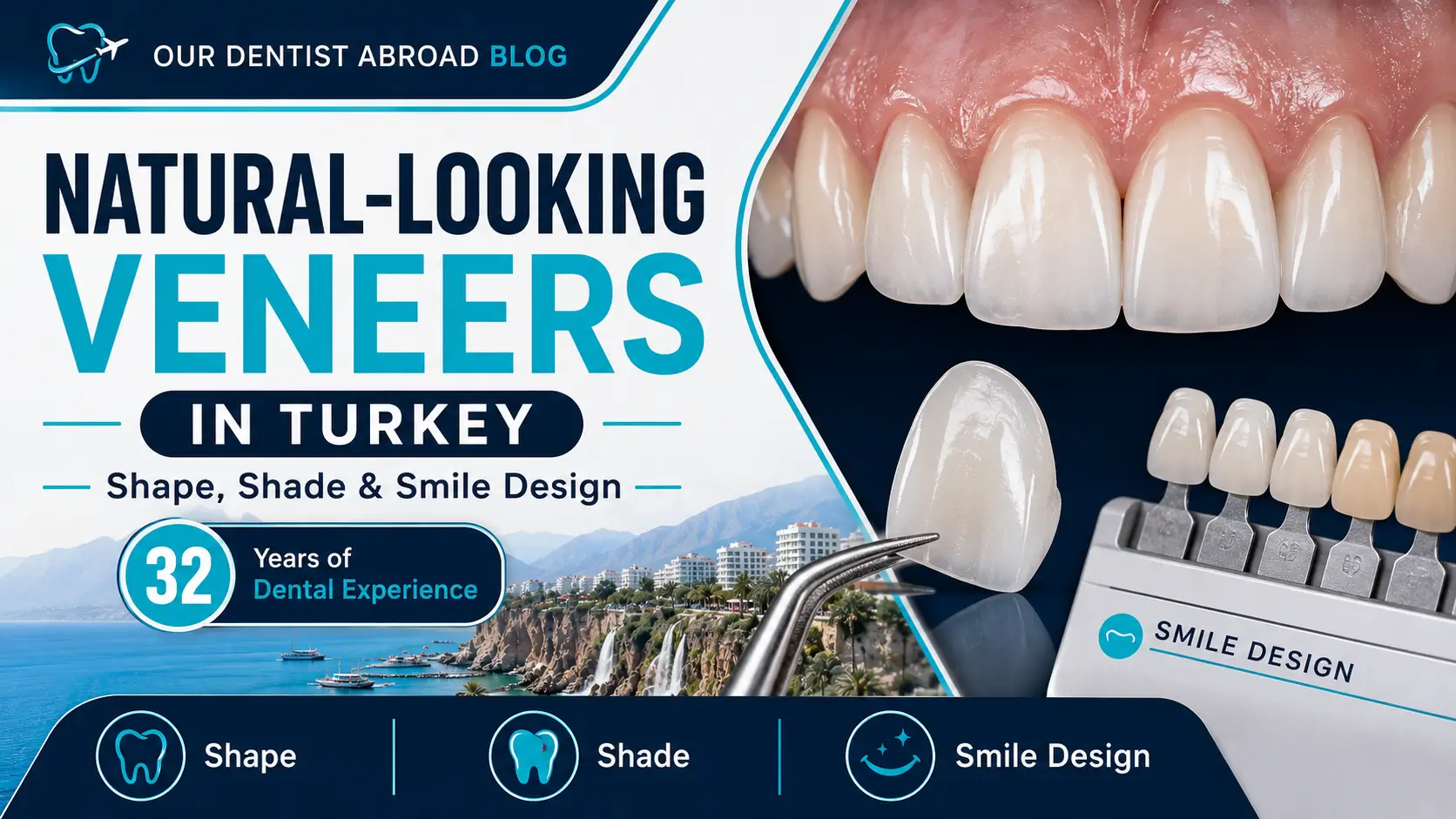
If you’ve been researching veneers in Turkey, you’ve probably also come across the phrase “Turkey teeth” — usually attached to a photo of teeth that look too big, too white and too uniform to be real. It’s a fair worry to have before you book anything. The good news is that veneers that look obviously fake are almost always the result of a rushed, one-size-fits-all approach, not a limitation of the material itself. Done properly, veneers are planned around your face, not applied from a template.
This guide explains what actually goes into a natural-looking smile design — shade, shape, translucency and the material choice behind it — so you know what questions to ask before you commit to treatment.
Why “Natural” Matters More Than “White”
A common misconception is that a better smile means a whiter smile. In reality, the whitest possible shade is rarely the most flattering one. Natural teeth are never a flat, uniform colour — they have subtle variation between the edge and the base of each tooth, and they reflect light differently depending on thickness and translucency. A skilled clinician treats shade as one part of a bigger picture that includes your skin tone, the whites of your eyes, and the shade of your existing teeth that won’t be treated, so the new teeth blend in rather than standing out.
Tooth Shade: Choosing a Colour That Suits You
Shade selection should happen with you in the room, in natural daylight rather than under clinic lighting alone, and ideally compared directly against a shade guide held next to your face. Reputable clinics will discuss a small range rather than pushing the brightest option on the chart. If a clinic skips this conversation entirely, or shows you a single “standard” shade used for every patient, that’s a sign the process is templated rather than personalised.
Face Shape and Lip Line: The Foundation of Smile Design
Shape matters as much as shade. Before any preparation work begins, your dentist should assess:
- Face shape — rounder faces often suit softer, slightly rounded tooth edges, while squarer faces can carry more defined corners.
- Lip line and smile width — how much tooth shows when you smile naturally, not just when you smile for a photo.
- Midline and symmetry — small natural asymmetries are usually kept, since perfect symmetry is what tends to look artificial.
- Tooth proportion — length-to-width ratio adjusted to your existing bone structure rather than a generic template.
At Our Dentist Abroad, this assessment draws on 32 years of dental experience in restorative and cosmetic planning, which matters most in exactly this stage — recognising which details make a smile look like it belongs to the person wearing it, rather than applying the same shape to every case.
Why E-max Veneers Look More Natural Than Standard Options
Material choice has a direct effect on how light passes through the veneer. E-max (lithium disilicate) is prized in smile design because of its translucency — it allows light to pass through and reflect off the tooth structure underneath in a way that mimics natural enamel, rather than reflecting off the surface in a flat, opaque way. This is particularly important for the front teeth, which are visible in almost every conversation and photo. Standard, thicker or more opaque veneer materials can look acceptable up close but tend to read as noticeably artificial in daylight or under camera flash — one of the most common causes of the “Turkey teeth” look.
E-max also allows for thinner preparation in many cases, which supports the aim of preserving as much of your natural tooth structure as possible.
What a Personalised Smile Design Process Looks Like
A properly planned case typically follows a clear sequence: photographs and, where needed, a 3D scan; a shade and shape consultation; a digital or physical mock-up you can review before permanent preparation; and only then, the veneer work itself. Being shown a mock-up and asked for your feedback before anything irreversible happens is one of the clearest indicators that a clinic is designing your smile around you rather than working from a fixed template.
Getting Started
If you’re comparing veneer options and want an honest opinion on whether your case suits a natural, lower-shade approach or would benefit from E-max specifically, send us a few clear photos of your smile — front-on, relaxed, and one wide smile — along with any concerns you have about shade or shape. We’ll come back with a realistic assessment and a plan tailored to your face, not a generic package.