



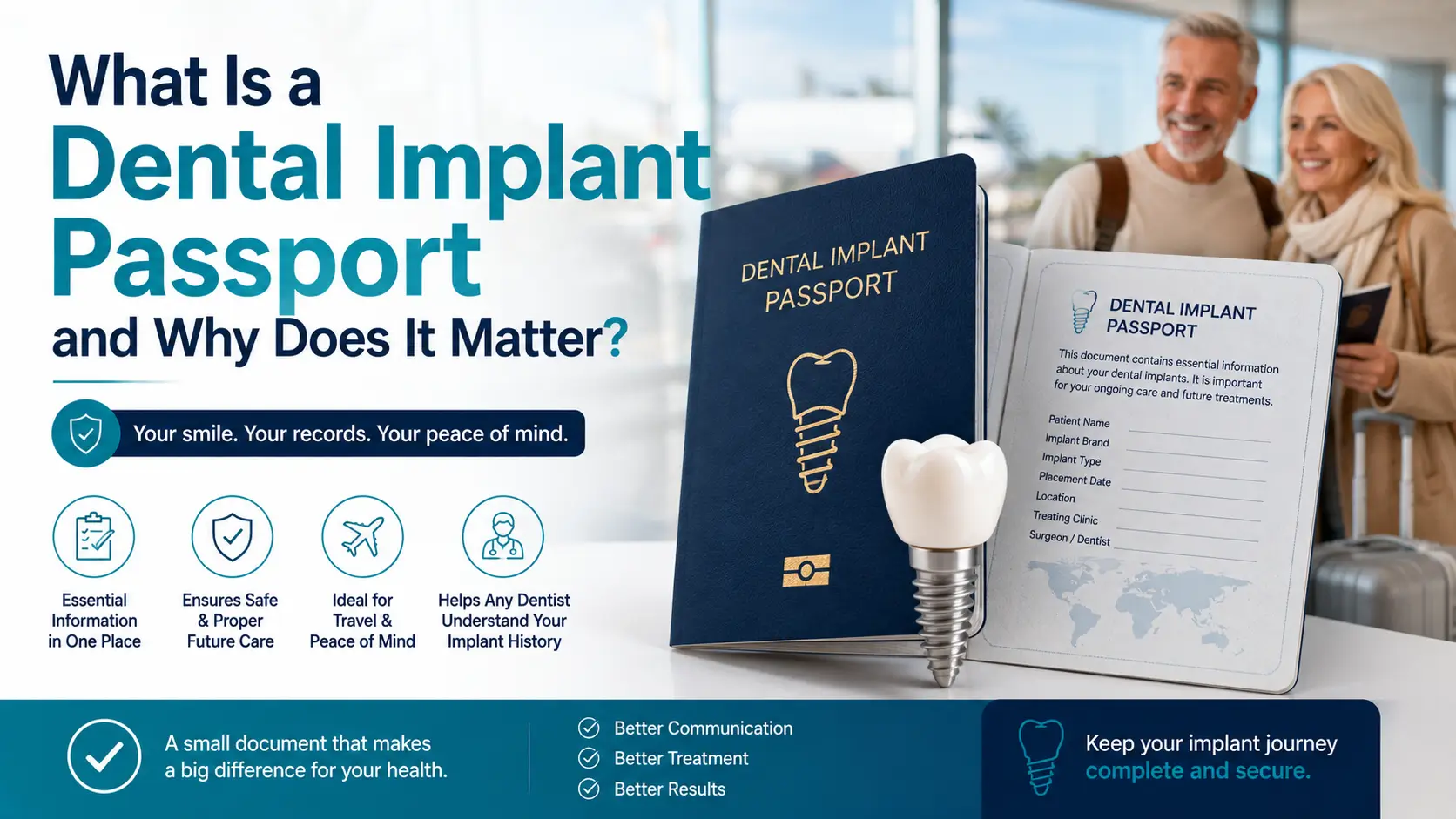
If you’ve had a dental implant placed abroad, there’s a simple piece of paperwork that can save you significant time, cost and confusion at every future dental appointment for the rest of your life: an implant passport. Despite how useful it is, many patients leave treatment without ever receiving one, simply because they didn’t know to ask. This guide explains exactly what an implant passport is, why it matters so much for UK-based aftercare, and how to make sure you get one before you fly home.
What a Dental Implant Passport Actually Is
An implant passport is a short document recording the specific details of every implant placed in your mouth: the manufacturer, the exact product line and model, the size (diameter and length), the position it was placed in your jaw, and the date of placement. Some clinics also include the batch or lot number from the manufacturer, along with details of the abutment and crown used on top of the implant. It’s essentially a technical specification sheet for your own implants, kept in your own records rather than only on file at the clinic that placed them.
Why This Information Is So Easy to Lose Track Of
Once your implant is fitted and functioning well, it’s easy to forget the specific details ever mattered — until years later, when something needs attention and a dentist asks exactly which implant system is in your jaw. Unlike a filling or a crown, which any dentist can usually assess visually, implant components are brand- and model-specific, and the wrong assumption about which system is in place can lead to real complications when trying to source a compatible abutment or repair part.
Why It Matters So Much for UK Aftercare
If you ever need any adjustment, repair or replacement work on an implant placed in Turkey, your UK dentist will need to know precisely which system was used before they can order compatible components or even attempt certain procedures. Without this information, your dentist may need to take additional scans or X-rays simply to try to identify the implant system by its visible shape — a process that’s neither guaranteed to succeed nor quick, and one that adds unnecessary cost and delay to what might otherwise be a straightforward fix.
What Happens Without One
Patients without an implant passport who later need attention on their implant often face a frustrating process: their UK dentist has to attempt identification through imaging, sometimes contact the original clinic directly (if it’s still reachable and responsive), or in some cases refer the patient to a specialist purely to identify what’s actually in their jaw before any treatment planning can even begin. This is entirely avoidable with a single document handed over at the end of treatment.
What a Good Implant Passport Should Include
- Manufacturer name and specific product line (for example, a named system rather than just “titanium implant”).
- Implant diameter and length for each individual implant placed.
- The specific tooth position of each implant, using standard dental notation.
- Date of placement and the treating clinic’s contact details.
- Abutment brand and type, along with the crown material used.
- Batch or lot number, where the manufacturer provides one, for full traceability.
How to Make Sure You Get One
The simplest approach is to ask directly, before treatment begins, whether an implant passport or equivalent documentation is provided as standard, and in what format — a printed card, a PDF, or both. Reputable clinics working with UK and other international patients should have this as a routine part of their process, since it reflects well on their own record-keeping as much as it helps you. If a clinic seems unfamiliar with the concept or unable to confirm they provide one, it’s worth asking again in writing, or treating it as a signal to look more closely at their overall documentation standards.
Keeping Your Passport Safe and Useful
Once you have your implant passport, keep both a physical copy and a digital photo or scan saved somewhere accessible, such as your phone or email, so it’s available even if the original paperwork is misplaced. It’s worth bringing a copy to every future dental appointment, even routine check-ups, so your UK dentist has it on file from the outset rather than only needing it in an emergency. With 32 years of dental experience supporting patients well beyond their treatment dates, this simple habit consistently makes future dental care smoother, faster and less stressful whenever any attention to the implant is needed.
What If You’ve Already Had Treatment Without One
If you’ve already had an implant placed and never received a passport, it’s still worth contacting the original clinic directly to request the details on record — most clinics keep this information even if it wasn’t handed over automatically at the time. If the clinic is no longer reachable, your UK dentist may still be able to identify the system through imaging analysis, though this is a less reliable fallback than simply having the documentation in hand.
Implant Passports and Travel Insurance
An implant passport can also be useful beyond dental visits — some travel insurance policies and medical alert systems ask for details of any implanted medical devices, and titanium dental implants can occasionally trigger questions during certain security or medical screening contexts. Having a simple document on hand that confirms exactly what was placed, when, and by whom removes any uncertainty in these situations, however rare they may be.
A Small Document With Long-Term Value
It’s easy to underestimate how much a single piece of paperwork matters when everything is healing well and functioning normally. The real value of an implant passport tends to reveal itself years later — at a house move to a new dentist, an unrelated dental emergency, or simply routine ageing of the restoration — moments when having clear, specific documentation turns a potentially confusing appointment into a straightforward one.
Digital Records as a Backup
Many clinics are now moving toward digital patient portals where treatment records, including implant details, are stored and accessible online indefinitely, in addition to a printed passport handed over at your final appointment. If your clinic offers this, it’s worth asking for login access before you leave, since a digital backup that survives a lost piece of paper is a genuinely useful safety net on top of the physical document.
Asking for Your Passport at the Right Time
The best time to confirm you’ll receive an implant passport is before treatment begins, as part of your initial consultation questions, rather than trying to request it after the fact on your final day when the clinic team is focused on wrapping up your appointment. Building this into your pre-treatment checklist, alongside questions about warranty and brand, ensures it isn’t forgotten in the busyness of your final visit.
Comparing This to Other Medical Records You Already Keep
Most people already keep basic paperwork for things like glasses prescriptions or medication lists, precisely because this kind of specific, technical information isn’t something you’re expected to remember unprompted. An implant passport deserves the same treatment — filed away alongside other routine health documentation, ready to hand over the moment any dental professional needs it, rather than something you only think about once a problem has already arisen.
One More Reason It Matters: Peace of Mind
Beyond the practical, functional reasons, there’s a simple peace-of-mind benefit to holding a proper implant passport — knowing that, whatever happens in the future, you have everything a dentist would need to help you quickly and confidently, rather than facing uncertainty at exactly the moment you’d rather things be straightforward.
Why Reputable Clinics Provide This as Standard
Clinics genuinely confident in the quality of their materials and their long-term relationship with international patients tend to provide implant passports as a routine, unprompted part of their process, rather than something patients need to specifically request. If you’re comparing clinics and this comes up naturally in their process description without you having to ask, it’s a reasonably good sign of an operation that thinks carefully about patient care beyond the day treatment finishes.
A Quick Checklist Before You Leave Turkey
Before your final appointment ends, it’s worth confirming you’re leaving with the implant brand and model in writing, the size and position of each implant, warranty documentation for both the implant and the clinic’s own workmanship, and clear contact details for future questions. Ticking through this short list takes only a few minutes but ensures nothing is missed in the natural rush of packing up and heading to the airport.
Getting Started
If you’re planning implant treatment and want to make sure proper documentation is built into your plan from the outset, send us a note on what you’re considering, and we’ll confirm exactly what records you’ll receive, including a full implant passport, once your treatment is complete.