



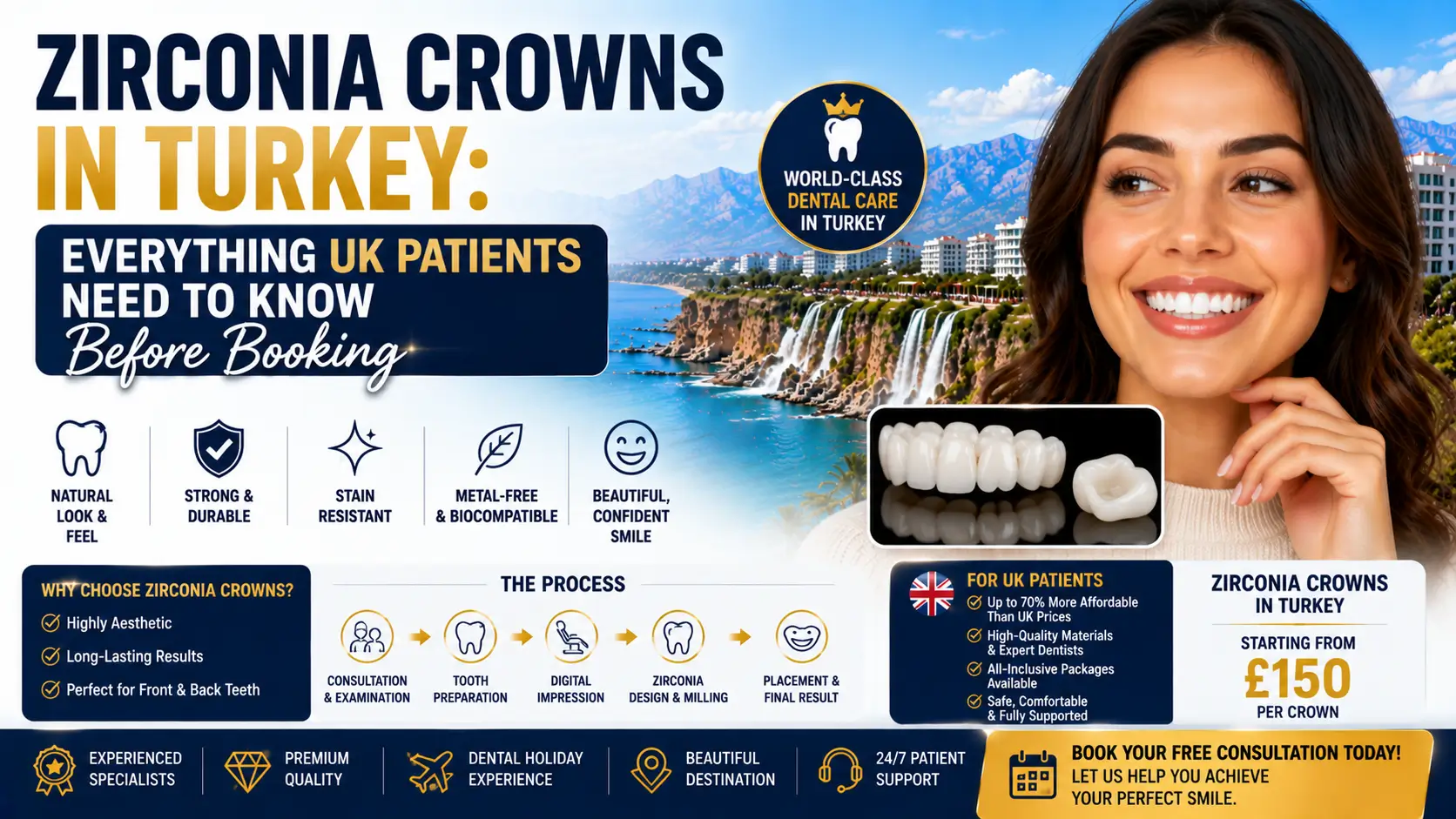
Dental crowns aren’t a single product. The term covers a range of materials — porcelain-fused-to-metal (PFM), full zirconia, E-max ceramic, and composite — each with different properties, different lifespans, and different indications. The crown your UK dentist quoted you for £600 might be very different from the one a clinic abroad is offering for £170 — or it might be virtually identical. The only way to know is to ask about the material specifically.
This guide explains what zirconia is, how it compares to the other options, when a crown is the right choice versus a veneer, and what the process looks like in Antalya. It’s a practical guide — not a sales pitch.
What Is a Zirconia Crown?
Zirconia (zirconium dioxide) is a high-performance ceramic originally developed for industrial and aerospace applications. In dentistry, it’s used to produce crowns that are exceptionally strong, highly biocompatible, and free of metal. The material is milled from a solid block using a computerised CAD/CAM process, which allows for very precise fit and consistent quality.
Full zirconia crowns have become the most widely used crown material in modern restorative dentistry — in Turkey, the UK, the United States, and everywhere else with access to current CAD/CAM technology. Their combination of strength, aesthetics and longevity makes them the default recommendation for most crown cases.
| £600–£1,000Typical zirconia crown cost at a UK private practice | from £170Zirconia crown at Our Dentist Abroad, Antalya | 20+ yrsExpected lifespan of a well-placed zirconia crown | 32 yrsOur Dentist Abroad placing crowns in Lara |
Zirconia vs E-max vs Porcelain-Fused-to-Metal: What’s the Difference?
There are three main materials used for dental crowns in modern clinical practice. Here’s how they compare:
| Property | Full Zirconia | E-max (Lithium Disilicate) | PFM (Porcelain-fused-to-metal) |
| Strength | Extremely high — best for posterior (back) teeth | High — suitable for all positions | Good — but metal substructure adds bulk |
| Aesthetics | Excellent — translucent options available | Outstanding — most natural-looking | Adequate — can show grey margin at gum line over time |
| Metal content | None — fully metal-free | None — fully metal-free | Contains metal core — not suitable for metal-sensitive patients |
| Durability | 20+ years with proper care | 15–20 years | 10–15 years before potential margin issues |
| Best suited for | All teeth, particularly molars and premolars | Front teeth where aesthetics is priority | Budget-conscious cases — increasingly being replaced by zirconia |
| Antalya cost | from £170 | from £150 | from £100 |
At Our Dentist Abroad, our default crown material is full zirconia for posterior teeth and E-max for anterior (front) teeth where a higher aesthetic standard is required. We will always tell you which material we’re recommending and why — and confirm it in writing before treatment begins.
Crown vs Veneer: How Do You Know Which You Need?
This is one of the most common sources of confusion for patients researching cosmetic and restorative dentistry. The distinction is important because a crown requires significantly more tooth reduction than a veneer, and the wrong choice can have long-term consequences.
| Clinical situation | Crown recommended | Veneer recommended |
| Tooth structure remaining | Tooth is heavily filled, cracked or structurally compromised | Tooth is largely intact with healthy underlying structure |
| Root canal treatment | Yes — root-treated teeth are brittle and benefit from full crown protection | Not typically — intact non-RCT teeth are better suited to veneers |
| Location in mouth | Back teeth (molars, premolars) where strength is the priority | Front teeth where aesthetics is the priority and bite force is lower |
| Purpose | Restoring function and protecting a damaged or weakened tooth | Improving the appearance of a sound tooth |
| Extent of coverage | Covers the entire tooth, including the chewing surface | Covers only the front (labial) surface of the tooth |
| Tooth reduction required | More significant — typically 1.5–2mm all around | Minimal — typically 0.3–0.7mm from the front surface only |
| If a clinic recommends crowns on intact, healthy front teeth when veneers would achieve the same aesthetic result, that’s a red flag. More tooth reduction is not better dentistry — it’s the opposite. |
Price Comparison: UK vs Antalya
| Crown type | UK private (per tooth) | Antalya (per tooth) | Saving |
| Full zirconia crown | £600–£900 | from £170 | up to £730 |
| E-max ceramic crown | £700–£1,000 | from £150 | up to £850 |
| PFM crown | £400–£700 | from £100 | up to £600 |
| Zirconia crown on implant | £700–£1,000 | from £200 | up to £800 |
| Full set of crowns (16 teeth) | £9,600–£16,000 | from £2,720 | up to £13,280 |
The Crown Process in Antalya: How Long and What’s Involved
A crown treatment at Our Dentist Abroad typically takes five days — one day shorter than a veneer course, because there’s no Digital Smile Design session required for posterior (back) teeth. Here’s the breakdown:
| Day 1 | Arrival in Antalya. Transfer to hotel. Rest. |
| Day 2 | Clinical assessment: X-rays, photographs. Tooth examination and treatment planning confirmed. For anterior (front) teeth crowns, shade matching and any digital design work completed. |
| Day 3 | Tooth preparation: the tooth is shaped to receive the crown. An impression (digital or physical) is taken. A temporary crown is fitted so you’re comfortable whilst the permanent crown is made in our in-house lab. |
| Day 4 | Laboratory day. Your crown is milled in our on-site CAD/CAM laboratory. Full free day. |
| Day 5 | Crown fitting: the permanent crown is cemented. Bite carefully checked and adjusted. Aftercare instructions given. Written guarantee provided. Transfer to airport. |
Our Crown Quality Protocol
Every crown at Our Dentist Abroad is made in our own on-site ceramics laboratory — not outsourced to an external lab. This means the dentist treating you and the ceramist making your crown work in direct communication, which matters particularly for front teeth where shade matching and translucency require fine judgement.
Before any crown is placed, we confirm the material in writing and show you the restoration for approval. For front teeth, we check the shade in natural light — not just under the clinical lamp, which can make even a poor shade match appear adequate.
All crowns come with a written guarantee. For manufacturing or placement faults within the guarantee period, we replace the crown at no charge.
Frequently Asked Questions
Is the zirconia used in Turkey the same quality as in the UK?
Yes. Zirconia is a globally standardised material with CE certification requirements across Europe. The same grades of zirconia used at leading UK private practices are available in Antalya. What varies between clinics is the precision of the milling, the skill of the ceramist, and the quality control at the fitting stage — not the raw material. We use a dedicated CAD/CAM system and in-house ceramics laboratory, and we confirm the material specification in writing before treatment.
How long does a zirconia crown last?
With proper care, a well-placed zirconia crown should last 20 years or more. This depends on good oral hygiene, avoiding habits that put excessive force on the crown (biting hard objects, grinding without a night guard), and regular dental check-ups. We provide full maintenance guidance before you leave Antalya.
Can I have a crown done on the same trip as other treatment?
Yes — and this is one of the practical advantages of travelling for treatment. A crown course (five days) fits neatly alongside a veneer course (five to seven days), a teeth whitening treatment, or other cosmetic work. We can plan a combined treatment schedule that makes efficient use of your time in Antalya, so you’re not making multiple separate trips for treatments that could sensibly be combined.
My NHS dentist told me I need a crown. Will you confirm this?
Yes — we review all X-rays and photographs sent to us before issuing a treatment plan, and we carry out a full clinical assessment on arrival. If a crown is clinically indicated, we’ll confirm it. If we think there’s a more conservative approach that achieves the same result, we’ll say so. We will never recommend more treatment than your case actually requires.
What if the crown doesn’t fit properly or I’m unhappy with the result?
Before the permanent crown is cemented, it is tried in for your approval — shape, shade and bite are all checked. If anything isn’t right, adjustments are made before cementing. If a genuine issue arises after you’ve returned to the UK, contact us and we’ll assess it remotely within 24 hours. If the crown requires replacement for a reason attributable to our work, we’ll arrange your return to Antalya and replace it under the guarantee.
| Not sure whether you need a crown or a veneer? Send us your photos and X-rays for a free expert opinion — we’ll give you a clear answer and a written quote within 24 hours. |