



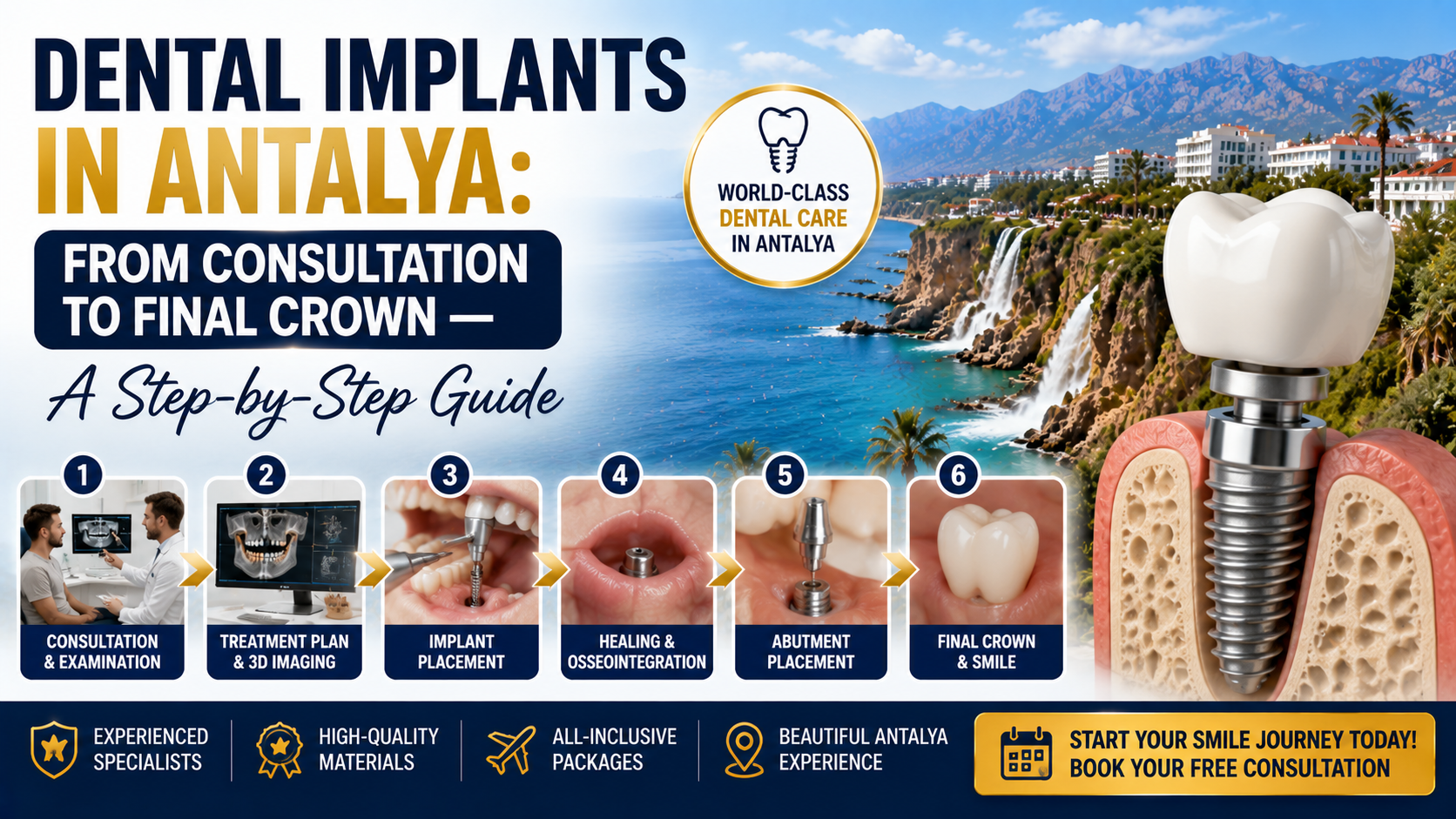
| Most patients think getting a dental implant in Turkey takes one trip. The truth is more nuanced — and understanding the process is key to a successful outcome. |
A dental implant is not like a filling or a crown. It is a surgical procedure followed by a biological process — osseointegration — during which the titanium fixture bonds with your jawbone over a period of three to six months. This process cannot be safely shortened, and it doesn’t happen on a dentist’s chair. It happens at home, in your body, whilst you carry on with ordinary life.
What this means, practically, is that implant treatment requires two separate visits to Antalya — typically three to five days each — with a healing period of three to six months in between. This isn’t a workaround or a limitation of Turkish dentistry. It’s the same clinical protocol used at every reputable implant practice in the world, including the finest private clinics on Harley Street.
Understanding the process before you travel means you’ll know exactly what to expect at each stage, why each step matters, and what’s happening during the months between your visits. This guide covers all of it.
| 2Separate visits to Antalya required | 3–6 moOsseointegration healing period at home in UK | 32 yrsOur Dentist Abroad placing implants in Lara | 20+ yrsOur lead implantologist’s clinical experience |
Before You Travel: The Remote Consultation
A well-run implant process begins before you set foot on a plane. Here’s what should happen before your first visit:
| What a proper pre-travel consultation includes |
| ✓ You send recent X-rays (panoramic or 3D, if you have them) and photographs of the affected area |
| ✓ The clinic reviews your case and produces a provisional treatment plan — including whether bone grafting may be required |
| ✓ You receive a written, itemised quote in sterling — covering the implant fixture, abutment, crown, 3D CBCT scan, and all clinical appointments |
| ✓ Estimated treatment timeline is confirmed — single tooth, multiple implants, or full-arch cases have different schedules |
| ✓ Your patient coordinator discusses travel arrangements, hotel options and airport transfer |
At Our Dentist Abroad, we respond to all enquiries with a provisional treatment plan and itemised quote within 24 hours. The consultation is free and carries no obligation to proceed.
Visit 1: Consultation, 3D Scanning and Implant Placement
Your first visit to Antalya typically lasts three to five days. Here’s what happens:
| Day 1 | Arrival in Antalya. Transfer to hotel. Rest. |
| Day 2 | Clinical assessment: Full 3D CBCT scan and panoramic X-ray. Photographs and shade records taken. Face-to-face consultation with your implantologist — treatment plan confirmed, any adjustments discussed. You are given a clear written explanation of the procedure, healing expectations, and aftercare protocol before giving consent. |
| Day 3 | Implant placement surgery: carried out under local anaesthetic (sedation available on request). The titanium fixture is placed into the jawbone at the position of the missing tooth. A temporary restoration may be fitted in the same appointment depending on the case. Post-operative care instructions provided. Most patients experience mild discomfort for 2–3 days, managed effectively with standard over-the-counter painkillers. |
| Day 4 | Post-surgical review: clinical check of the surgical site. Sutures assessed. Any concerns addressed. |
| Day 5 | Final check if needed. Transfer to airport. Home. |
The Healing Period: What’s Happening at Home
Once you’re back in the UK, the most important part of the implant process begins — and it doesn’t require you to do very much at all. Osseointegration is the biological process by which the surface of the titanium fixture bonds with the surrounding bone tissue. Over a period of three to six months, new bone cells grow into the micro-textured surface of the implant, creating a joint that is, in most cases, stronger than the original tooth root.
During this period, there are a few things to be aware of:
| Normal during healing | Contact us if you notice |
| ✓ Mild tenderness for the first few days | ⚠ Swelling that worsens rather than improves after week 1 |
| ✓ Minor bruising around the jaw or cheek | ⚠ Persistent bleeding or discharge from the surgical site |
| ✓ Some sensitivity to temperature around the site | ⚠ Visible movement or looseness of the implant |
| ✓ Gradual return to normal eating over 1–2 weeks | ⚠ Pain that is not controlled by standard painkillers |
| ✓ Temporary restoration may feel slightly different to natural teeth | ⚠ Any noticeable change in the fit or feel of the temporary restoration |
We follow up proactively with all implant patients at three months post-treatment. If you have any concerns at any point between visits, your patient coordinator is available by WhatsApp and email, and we can arrange a video consultation with the clinical team within 24 hours.
Visit 2: The Permanent Crown
Once osseointegration is complete — confirmed by a 3D scan at the beginning of your second visit — the permanent crown is fitted. This second visit is shorter: two to three days is typically sufficient.
| Day 1 | 3D CBCT scan to confirm osseointegration is complete. Clinical assessment of the implant site. Shade matching for the final crown. |
| Day 2 | Crown fitting: the abutment is connected to the implant fixture and the final crown (typically zirconia or E-max) is fitted and cemented. Bite is carefully checked and adjusted. Photographs taken. |
| Day 3 | Final check and adjustments if needed. Implant passport issued — documenting the exact brand, model and batch number of your implant, for your UK dentist’s records. Transfer to airport. |
Our Implant Protocol at a Glance
| Standard | Our Dentist Abroad |
| Implant brands used | Straumann, Nobel Biocare, Osstem — confirmed in writing before treatment |
| Pre-surgical imaging | Full 3D CBCT scan for every implant case — included in the quoted price |
| Surgical guidance | 3D-guided surgical templates used in complex cases for precision placement |
| Healing period | 3–6 months — proactive remote follow-up throughout via WhatsApp / video call |
| Final restoration | Zirconia or E-max crown — matched to adjacent teeth, approved before fitting |
| Documentation | Full implant passport issued: brand, model, batch number, placement date, torque values |
| Guarantee | Written guarantee covering placement-related failure — terms provided before treatment |
| UK aftercare | Written treatment summary for your NHS or private dentist. Nottingham UK office available. |
Frequently Asked Questions
Is it safe to fly home after implant surgery?
Yes. Most patients fly home 24–48 hours after implant placement without any complications. Flying does not affect the healing process. We advise avoiding flying within the first 24 hours, and we provide specific guidance on managing any residual discomfort during travel. Your patient coordinator will advise on the optimal timing based on your specific case.
What if I need a bone graft?
Bone grafting is required when there is insufficient bone density or volume to support an implant. This is assessed from your 3D CBCT scan before any surgery. If a graft is needed, it can typically be performed at the same appointment as implant placement (a simultaneous graft), or as a separate procedure allowing healing before the implant is placed. We’ll confirm this in your treatment plan before you travel. Bone grafting in Antalya costs significantly less than in the UK — typically starting from £200–£350 vs £800–£1,500 in most UK private practices.
What brand of implant will you use?
We work with Straumann, Nobel Biocare and Osstem — the same internationally recognised systems used at leading private practices in the UK. The specific brand and model recommended for your case depends on the clinical requirements — we confirm this in writing before you travel, and you receive an implant passport on completion documenting the exact brand, model and batch number.
Can I have multiple implants placed in one visit?
Yes — multiple implants can be placed in a single surgical appointment, which is one of the practical advantages of travelling for treatment rather than spacing individual appointments over months. The number of implants that can be placed simultaneously depends on your bone anatomy and overall health, which we assess from your 3D scan. For full-arch cases (All-on-4 or All-on-6), all implants are placed in one appointment.
How long will my implant last?
With proper care, a well-placed implant from a quality manufacturer should last a lifetime. The titanium fixture itself is extraordinarily durable — implants placed 30 years ago are still functioning well in many patients. The crown on top typically lasts 15–25 years before requiring replacement. The longevity of the whole system depends on good oral hygiene, regular check-ups, and avoiding habits that put excessive load on the implant (such as grinding without a night guard).
What does my NHS dentist need to know about my implant?
Your NHS dentist can monitor your implant in the same way they would monitor any dental restoration — checking the bite, the gum health around the implant, and the condition of the crown. To do this properly, they need documentation: the brand and model of the implant, the placement date, and the crown specifications. All of this is provided in the implant passport and written treatment summary we give you before you leave Antalya.
| Start with a free online consultation — share your X-ray or photos via WhatsApp and receive a personalised treatment plan and itemised quote within 24 hours. |